
The stretch of coast between Lagos and Albufeira holds the highest density of sea caves in Portugal, sculpted into limestone and sandstone cliffs over millions of years. The Benagil Cave is the best known, but there are arches, sinkholes and cavities just as spectacular at Ponta da Piedade, in Carvoeiro and near Armação de Pêra that see a fraction of the visitors.
Almost all of them can only be reached from the water — by boat, by kayak or by stand-up paddle — and those who sleep near the right marina catch them before the mid-morning crowds.
Where are the Algarve caves?
The Algarve caves are concentrated in the Barlavento and Central Algarve, along a strip of limestone and sandstone coast running from Ponta da Piedade, in Lagos, to the area of Benagil and Albandeira, in the municipality of Lagoa. It is here that the soft rock was carved by the waves over millennia, forming arches, tunnels, sinkholes (openings in the roof) and cavities where the water flows in with the tide.
East of Albufeira the coast changes character: the limestone gives way to red sandstone cliffs and then to the barrier islands of the Ria Formosa, in the Sotavento, where there are no longer any sea caves. That is why, when people talk about caves in the Algarve, they almost always mean this stretch between Lagos and Lagoa, with Portimão and Carvoeiro at its geographic centre.
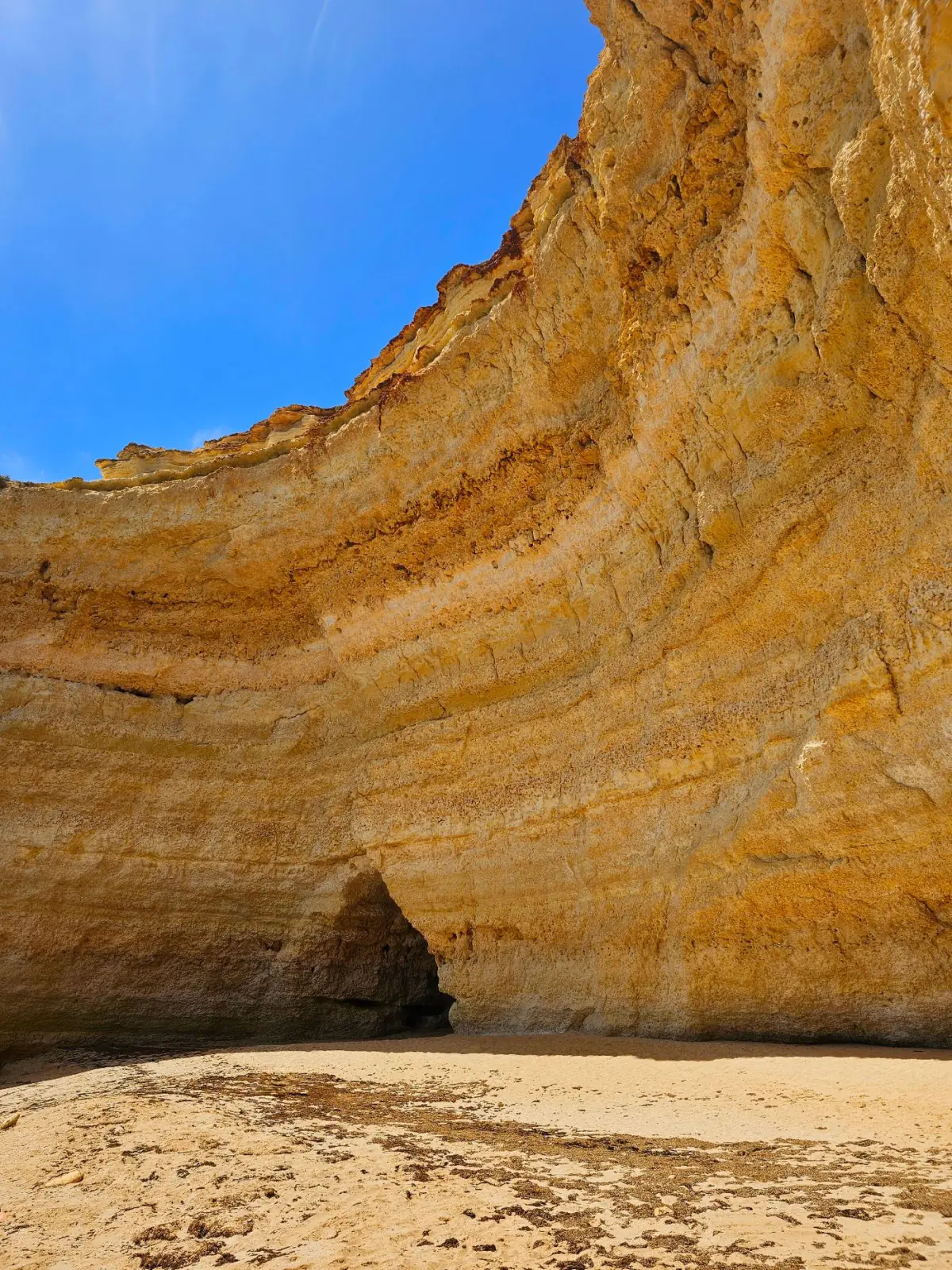
The practical advantage of this map is simple: in choosing where to stay, you also choose how far you are from the marinas the trips set off from. Those who sleep in Portimão, Ferragudo or Carvoeiro have the main caves on their doorstep; those who stay in Lagos have Ponta da Piedade minutes away.
Which caves are worth visiting beyond Benagil?
Beyond Benagil, those clearly worth the visit are Ponta da Piedade (Lagos), the caves of Carvoeiro and Algar Seco, the arch at Praia da Albandeira and the cavities of Praia dos Três Irmãos, in Alvor. All have scenery on a par with Benagil and, on most days, far fewer people.
Ponta da Piedade, Lagos
Ponta da Piedade is the most spectacular cluster of caves and arches in the Barlavento. They are columns of golden rock, tunnels and little beaches reachable only from the water, south of the town of Lagos. The traditional small boats leave from the marina and from Praia de Dona Ana, and there are kayaks too. The early-morning light, with the low sun pouring through the arches, is the best for photography — and it is just a few minutes by boat from Praia de Dona Ana and Praia do Camilo.
Algar Seco and the caves of Carvoeiro
In Carvoeiro, Algar Seco is one of the few formations you can also explore on foot, via a stairway from the village, with rock chimneys and the famous natural window "A Boneca". But it is from the water that you reach the real caves of this area, along a short stretch between Carvoeiro and Praia do Paraíso. As Carvoeiro lies halfway between Lagos and Albufeira, it makes an excellent base for visiting several caves in a single day.
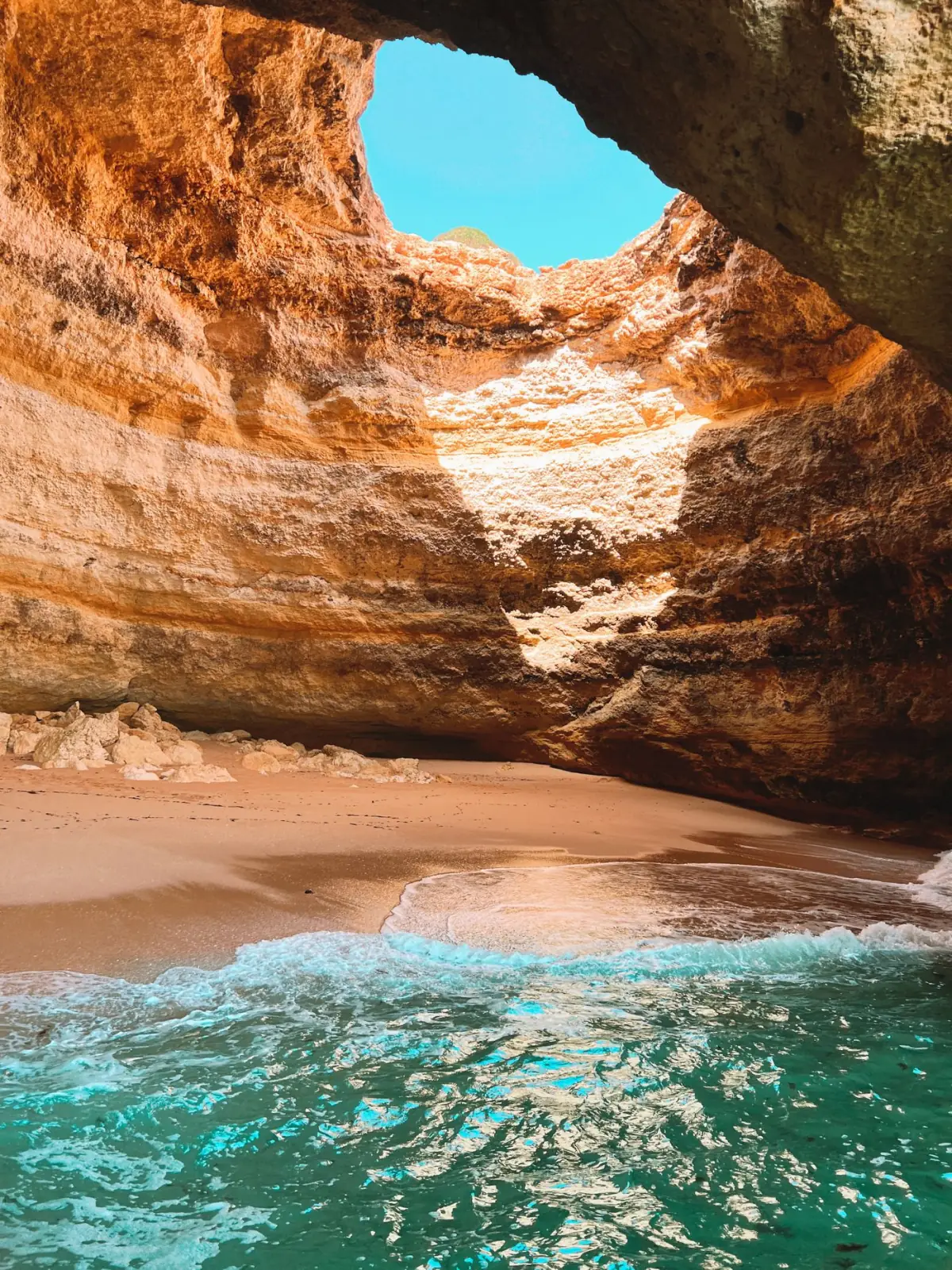
Praia da Albandeira and Praia dos Três Irmãos
The natural arch of Praia da Albandeira, near Armação de Pêra, is one of the most photographed scenes in the Algarve outside Benagil and can be seen by boat or kayak. Further west, beside Alvor, Praia dos Três Irmãos has tunnels and pierced rocks you can walk through at low tide. They are natural stops for anyone working the coast between Portimão and Albufeira.
Adding these formations to the Benagil Cave itself, you see why a single boat trip rarely does: the coast has enough caves for several days of exploring.
How do you reach the caves: boat, kayak or stand-up paddle?
Almost all the Algarve caves can only be reached from the water, and there are three ways to do it: boat trip, kayak and stand-up paddle. The choice depends on the weather, the budget and how close you want to get inside the cavities.
- Boat trip — the most common and comfortable option, on a larger vessel or a RIB. It covers more coast in less time and is ideal for families and for anyone who wants to combine caves with looking for dolphins on the same trip.
- Kayak — goes where boats cannot reach and lets you stop inside small caves. It calls for some physical effort and a calm sea; many operators carry the kayak close to the caves on a mother boat.
- Stand-up paddle (SUP) — the quietest way and the closest to the water, suited to a very calm sea and to those who already have some balance practice.
- Water taxi — in spots like Benagil, short boats run only the in-and-out of the cave, without the full coastal trip.
Departures cluster at the marinas and beaches of Portimão, Ferragudo, Carvoeiro, Lagos and Armação de Pêra. Book ahead in high season and always check whether the price does or does not include actually going inside the cave — some cheaper trips only pass by offshore.
What are the rules for visiting the Benagil Cave?
Since 2024 it has been forbidden to swim to the Benagil Cave unaccompanied, and swimming access from the beach has been restricted for safety reasons. In practice, today you only enter the cave on licensed boats or kayaks, and there are limits on the number and the time of the vessels inside at the busiest hours. These rules are set by the maritime authorities and can be adjusted every year, so always confirm the current situation before booking.
The tide also calls the shots: with a very high tide or a swell, operators do not go inside the cave for safety reasons, and the trip becomes purely coastal. So the best option is to choose early-morning departures, when the sea tends to be calmer and the light comes in better through the roof's sinkhole.
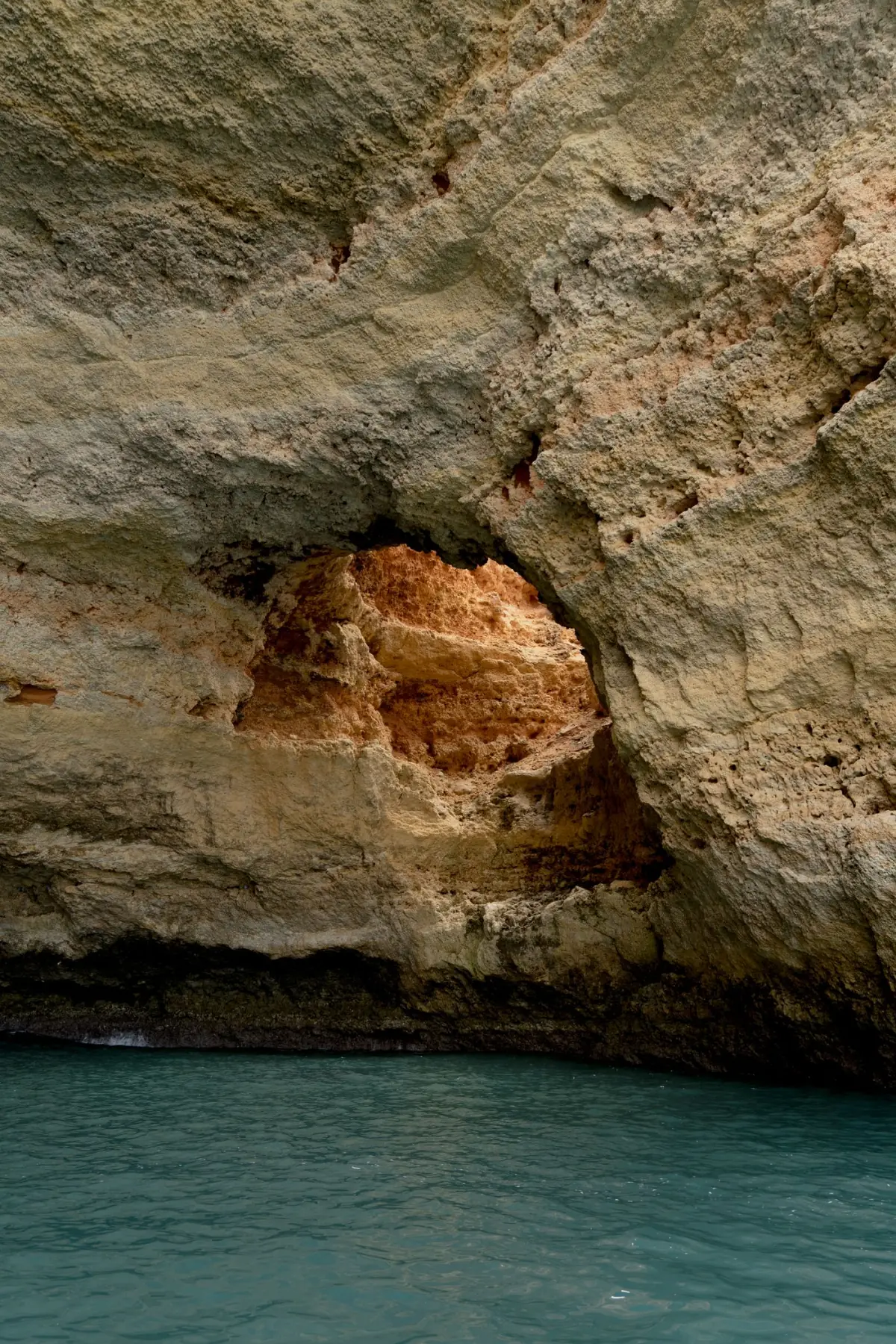
If the Benagil Cave is your main goal, it is worth reading our dedicated guide on how to visit the cave in 2026, with the rules, the types of tour and the best times explained in detail.
What is the best time of year to visit the caves?
The best time to visit the Algarve caves is between May and September, when the sea is calmer, the water warmer and operators run trips every day. In winter, the Atlantic swell cancels many trips and access to the cavities becomes unpredictable. The Barlavento marinas, unlike the beaches, live almost exclusively off the fine-weather season.
| Period | Sea and swell | Trip availability | Notes |
|---|---|---|---|
| May–June | Generally calm | High, with fewer people | Good light and prices still moderate |
| July–August | Calm, but busier | Maximum | Book early; morning departures to avoid the crowds |
| September | Calm, warm water | High | One of the best times: mild sea and fewer tourists |
| October–April | Frequent swell | Reduced or cancelled | Many operators close or only go out on good days |
Even within the high season, the time of day makes all the difference. The first departures, in the early morning, find a smoother sea and empty caves; by midday, in full August, the Benagil Cave can have dozens of boats at the entrance. That is why staying near the right marina is half the battle in catching the best window of the day.
Where to stay to reach the caves early?
To reach the caves early, the best bases are Portimão, Ferragudo, Carvoeiro and Lagoa, all within a few minutes of the marinas the trips set off from. Portimão has the largest marina in the Barlavento and the widest choice of operators; Carvoeiro puts you practically on top of the central caves; Ferragudo offers the feel of a fishing village a step from Portimão.
Portimão sits about 52 km from Faro Airport and concentrates many of the trips to the caves and the dolphin watching. A 4-bedroom apartment in Portimão of 70 m² works well for families or two couples who want to stay near the Portimão Marina and the sands of Praia da Rocha, while a 2-bedroom apartment in Portimão of 70 m² is a more compact option for a couple or small family.
Those who prefer to be right in the heart of the cave coast can opt for Carvoeiro: the 2-bedroom apartment in Carvoeiro of 90 m² sits in the village that gives direct access to Algar Seco and to the local boat and kayak departures. A 3-bedroom apartment in Lagoa of 130 m², in the municipality covering Carvoeiro, Ferragudo and Benagil, gives room for larger families and keeps all the marinas a short drive away.
Real-time availability and prices on Homing — book direct, cheaper than Booking, Airbnb and Hotels.com. Click «See dates and price».
All these homes are booked through direct booking on Homing, the official partner of Maré Algarve, which comes out cheaper than Booking, Airbnb and Hotels.com by charging no platform commission and no hidden fees, with support in Portuguese. You can compare areas in our guide to where to stay in the Algarve before settling on the ideal base for your caves.
How much does a cave trip cost and what to bring?
Trip prices vary a fair bit depending on the type of vessel, the duration and whether or not they include going inside the cave, so this guide does not fix figures: always confirm with the operator at the moment of booking. What we can guarantee is what is worth bringing to make the most of the trip and avoid a rough time.
- Sunscreen and a hat — out at sea the reflection burns far faster than on the beach.
- Clothes that can get wet and a towel — on a kayak and SUP you will definitely get wet; on a RIB there are splashes too.
- Footwear with grip — rubber sandals or water shoes, to get in and out without slipping.
- Phone or camera in a dry bag — to take photos without the risk of losing the gear in the water.
- Water and a light snack — above all on the longer trips combining caves and dolphin watching.
- Proof of booking — on paper or on your phone, for boarding time at the marina.
With this simple kit, any format — boat, kayak or SUP — becomes comfortable. What really makes the difference is not pricey gear, but choosing a calm-sea day and an early departure.
Is it worth combining caves, beaches and dolphins on the same day?
Yes, and it is one of the best ways to enjoy the coast. Many boat trips leaving from Portimão and Lagos combine the caves, a swimming stop at a secluded beach and dolphin watching offshore in a single route. As this whole coast is continuous, on a two-to-three-hour trip you see more than in a whole morning by land.
A good classic combination is to pair the caves with Praia da Marinha, considered one of the most beautiful in Portugal, which can be seen from the sea a few minutes from Benagil. Anyone wanting the land version finds it all in our complete guide to Praia da Marinha and in the guide to Carvoeiro, the ideal base village for this area.
For those travelling with children, the caves-plus-dolphins combination tends to deliver the most memorable day of the holiday. It is worth checking our guide to boat trips and dolphins in the Algarve beforehand, to work out which operators run the most complete departures and at what times there is the best chance of spotting the animals.
How to visit the caves safely and with respect for nature?
Visiting the caves safely starts with respecting three things: the sea, the access rules and the rock itself. The Algarve's limestone cliffs are fragile and there have been recorded collapses, so you should never walk beneath unstable cliffs or climb onto formations for photos. Inside the caves, avoid touching the walls and leave no litter — many of these cavities lie in sensitive coastal areas.
- Go with licensed operators and with life jackets for every passenger.
- On a kayak or SUP, do not enter caves in a swell; water that looks calm at the entrance can hit hard inside.
- Respect the access limits and timetables set for caves such as Benagil; they exist for everyone's safety.
- Keep your distance from the dolphins and never feed or chase the animals.
- Take back all your litter, including cigarette butts and packaging.
Following these simple rules ensures the experience is safe and that these caves stay intact for whoever comes next. The Algarve coast has withstood millions of years of sea; it falls to each visitor to help it last a few more.
Sources and references
- Turismo do Algarve (Visit Algarve) — https://www.visitalgarve.pt/
- Wikipédia — Algarve — https://pt.wikipedia.org/wiki/Algarve
- Wikipédia — Gruta de Benagil — https://pt.wikipedia.org/wiki/Gruta_de_Benagil
- Wikipédia — Ponta da Piedade — https://pt.wikipedia.org/wiki/Ponta_da_Piedade
- Capitania do Porto de Portimão (DGRM) — https://www.dgrm.mm.gov.pt/
- Câmara Municipal de Lagoa — https://www.cm-lagoa.pt/
Original editorial article by Maré Algarve, based on official sources (Turismo do Algarve, ICNF, ABAE/Blue Flag, IPMA, INE) and on our experience of holiday rentals in the Algarve. Prices and availability vary — always check each property's page.