
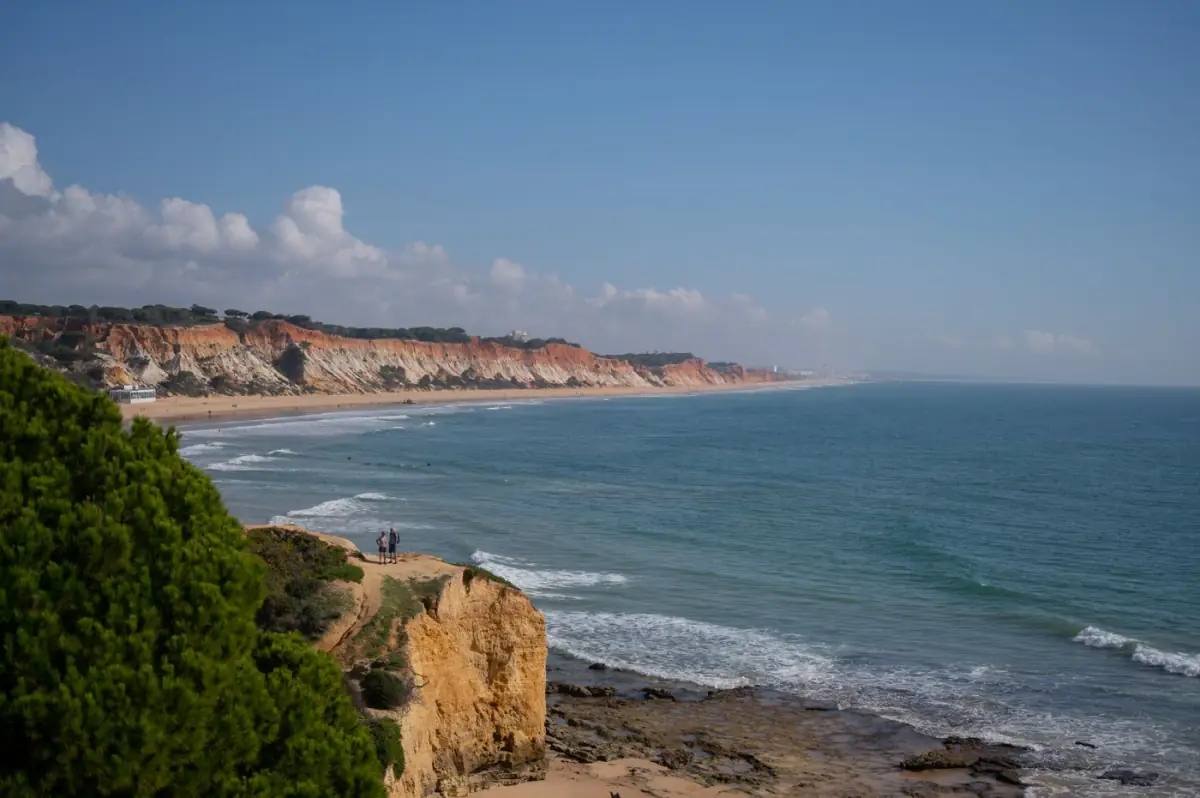
Praia da Falésia stretches some 6 kilometres of golden sand along a wall of red and ochre sandstone cliffs, crowned with pines, between Olhos de Água, in Albufeira, and Vilamoura, in the municipality of Loulé. It's one of the longest beaches in the Algarve, with a Bandeira Azul and easy access by car, and its striated cliff scenery makes it the beach most sought after by those who photograph the coast.
Where is Praia da Falésia and what makes it different?
Praia da Falésia occupies the stretch of coast in the Central Algarve (Golden Triangle) between Olhos de Água, at the eastern tip of the municipality of Albufeira, and the area of the Vilamoura marina, already in the municipality of Loulé. Unlike the small hidden coves of the Barlavento, it's a long, open beach: around 6 km of unbroken sand, facing south to the Atlantic.
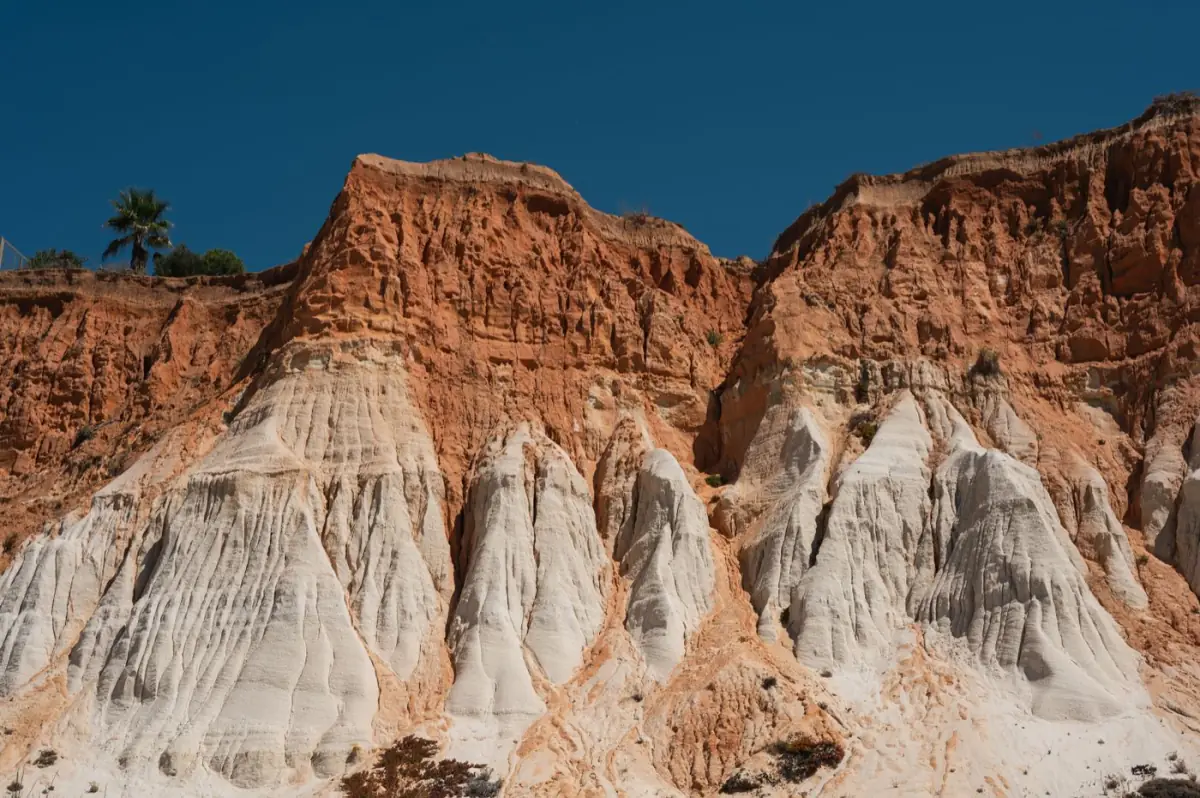
What sets this beach apart is the wall of cliffs that follows it from end to end. They are sandstone formations layered in red, ochre, orange and white, sculpted by erosion and topped by a gentle pinewood that reaches almost to the edge. It's this combination of rock colour, pine and pale sand that makes Falésia the most photographed beach in this part of the coast.
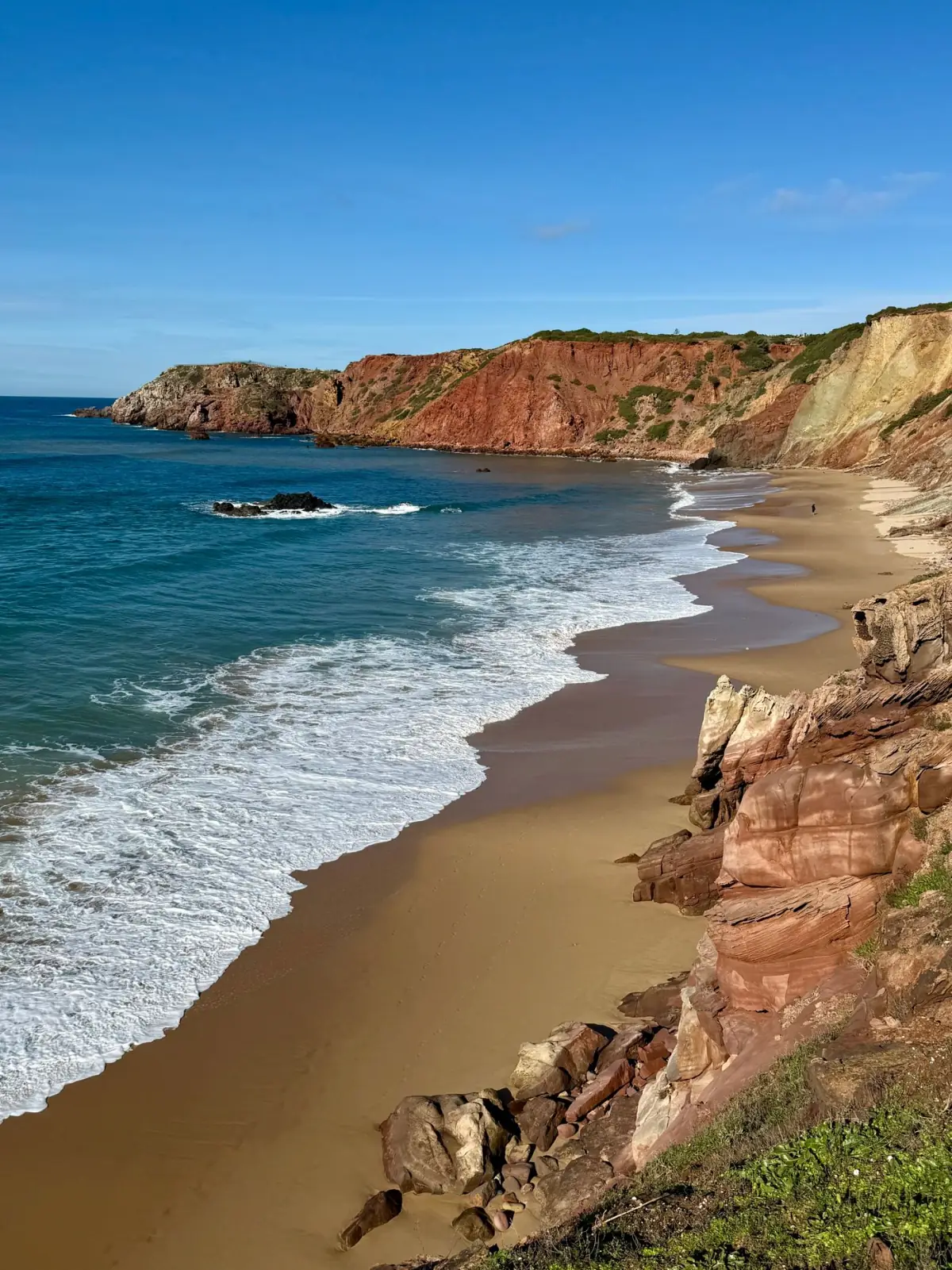
In practical terms, the beach works as two sides of the same coin. On the Albufeira side (Olhos de Água and the access by the former Falésia hotel), it has more of a resort-and-family feel; on the Vilamoura side (the Açoteias and Pine Cliffs area), it connects directly to the world of golf and the marina. Whoever chooses where to sleep is also choosing which end of the beach they enter from.
Why is Praia da Falésia so photogenic?
The answer lies in the geology. The cliffs are made of sandstones and clays with iron oxides, and it's that iron that paints the rock in tones ranging from white to brick-red, by way of oranges and ochres. Through the day, as the sun moves round, the same cliff changes colour — paler at midday, warmer and more saturated in late afternoon.
Above the cliffs grows a stone pinewood that descends in terraces and contrasts with the reddish rock. That green up top, the pale sand below and the blue of the sea create three bands of colour that make almost any framing worthwhile. For photography, the best light is in early morning, with the beach still empty, or at the golden hour before sunset.
The best spots to photograph
- The viewpoint by the Falésia hotel access (Albufeira side), looking down over the curve of the cliffs and the wooden stairway down to the sand.
- The Olhos de Água area, where freshwater springs surface in the sand at low tide and trace patterns across the beach.
- The wooden boardwalk over the dunes, on the Vilamoura/Açoteias side, which frames the pinewood and the coastline.
- The waterline at low tide itself, which greatly widens the sand and leaves the cliffs reflected in the wet sand.
Even without photographic ambitions, it's worth going down by one access and coming up by another: the perspective changes completely depending on whether you look at the cliffs head-on, from below or from the top. It's a beach that rewards those who walk a bit rather than staying put at the entrance.
How to get to Praia da Falésia by car and from the airport?
By car it's simple: Praia da Falésia lies around 26 km from Faro Airport on the Albufeira side and around 15 km on the Vilamoura side, both 20–30 minutes via the A22 or the EN125. There are several signposted accesses, each with its own car park, and the choice of access depends on where you're staying.
The main access points
- Olhos de Água (Albufeira): the western end of the beach, with the fishing village alongside and restaurants within walking distance.
- Açoteias / Falésia hotel: the central access, with the viewpoint above and the wooden stairway down to the sand.
- Vilamoura / Pine Cliffs: the eastern end, linked to the golf area and the Vilamoura marina.
Without a car, the most convenient option is to stay in Vilamoura or in Albufeira and take a taxi or local bus to the nearest access. The seasonal buses and the transfer offer link the two towns to the beach, but frequency drops off-peak, so having your own vehicle remains the most flexible option for exploring the whole coast. For the full transport picture, see the guide on how to get to and around the Algarve.
What's the best time of year to visit Praia da Falésia?
The best time for most people is between May and October, when the weather is settled, the sea milder and the days long. July and August are the hottest months and also the busiest; June and September offer practically the same beach climate with far fewer people and lower accommodation prices.
Facing south and open to the Atlantic, Praia da Falésia has cooler water and more present swell than the sheltered Sotavento beaches, like those of the Ria Formosa. On the other hand, its length is an advantage off-peak: even on a summer weekend, you only need to walk a few minutes to find almost deserted sand.
| Period | Atmosphere | Practical notes |
|---|---|---|
| May–June | Calm, warming up | Sea still cool; prices and crowds low, great for walking |
| July–August | Busy and hot | Peak heat and crowds; book access and parking early in the morning |
| September–October | Quiet, mild | Sea at its warmest of the year; golden light ideal for photography |
| November–April | Empty, cool | Good for long walks and photography; swimming only for the hardy |
If the aim is to photograph the cliffs or walk miles without crowds, early autumn is hard to beat. For a month-by-month plan of the whole region, it's worth cross-referencing this guide with the one on when to book a holiday in the Algarve.
Is Praia da Falésia good for families and for swimming?
Yes, with one caveat: Praia da Falésia has a Bandeira Azul, broad sand and a lifeguard in the bathing season, which makes it comfortable and safe for families, but the sea is the open Atlantic, with swell and currents that call for care with small children. On rougher days, it's best to stay near the supervised area and respect the flag.
In families' favour are the space (there's always somewhere to spread your towel away from the crowds), the beach facilities with food at the main accesses and the proximity of Olhos de Água, where the village and its restaurants sit a few steps from the sand. Access to the sand is via wooden stairways and ramps; with pushchairs, choosing an access with a ramp saves effort.
For those travelling with children and wanting to compare areas, beaches and types of home, the Algarve with children guide and the one on the best areas for families help decide between Falésia and more sheltered alternatives. The practical rule holds: an open, beautiful beach for the day, a comfortable base nearby for the night.
What is there to do besides being on the beach?
The big activity at Praia da Falésia is walking along the sand — you can cover several kilometres from one end to the other, with the cliffs always at your side. On top of the cliffs, the pinewood hides trails and the Vilamoura wooden boardwalk lets you stroll over the dunes without treading on the fragile vegetation.
Experiences around the beach
- Golf: the Vilamoura end concentrates some of the best-known courses in the Algarve, minutes from the sand.
- Vilamoura marina: restaurants, terraces and the departure point for boat trips and dolphin watching.
- Olhos de Água: the old fishing village, with its freshwater springs on the beach and fresh seafood in the restaurants.
- Albufeira: the old town, the historic quarter and the nightlife, a few kilometres from the western end of the beach.
For a different day, the cliff coast continues westwards to Carvoeiro and the Praia da Marinha, and the boat trips from Vilamoura or Albufeira reach the caves, including Benagil. Anyone staying several days in this area has material for a full itinerary beyond the beach.
Where to stay near Praia da Falésia?
The two natural bases are Vilamoura and Albufeira, one at each end of the beach. Vilamoura is the more sophisticated and quiet option, organised around the marina and golf, with a strong offer of modern apartments with pools; Albufeira is busier and more varied, from the old town to the resorts of the Olhos de Água area. For those hesitating between the two, comparing destinations helps grasp what each holiday profile calls for.
In between lies Quarteira, more affordable and with its own stretch of sand, a short distance from Falésia; anyone weighing up this base will find the best areas and beaches in the guide to Quarteira. At any of these points, most of those visiting this beach look for apartments with a shared pool or villas for groups and larger families, always a few minutes by car from the sand.
From our inventory in this area, three good examples on the Vilamoura side are the 2-bedroom apartment with pool in Vilamoura of 90 m², the 2-bedroom of 97 m² also in Vilamoura and the more compact 2-bedroom of 73 m², all with a pool and well positioned to reach Falésia and the marina. On the Albufeira side, the 1-bedroom apartment with pool in Albufeira of 71 m² is a practical base for a couple wanting to stay near Olhos de Água.
Real-time availability and prices on Homing — book direct, cheaper than Booking, Airbnb and Hotels.com. Click «See dates and price».
These homes are booked directly on Homing, our official partner, which is usually cheaper than Booking, Airbnb and Hotels.com as it charges no platform commission or hidden fees, with support in Portuguese, English, French and Spanish. Prices vary with the dates — confirm on each home's page before booking.
How to organise a day at Praia da Falésia without hassle?
The secret to a good day at Falésia is to arrive early and choose the right access. The car parks fill from mid-morning in high season, especially at the central access by the hotel; those who arrive before 10am secure a space and still catch the cool beach and the best light for photography.
A simple plan for the day
- Leave your home in Vilamoura, Albufeira or Quarteira early and head for the nearest access.
- Park, go down the stairway or ramp and walk a few minutes to escape the busiest area by the entrance.
- Bring water, a hat and sun protection — natural shade is scarce and the sun beats down strongly to the south.
- At lunch, head up to a beach facility or drive to Olhos de Água for fresh seafood.
- Stay for late afternoon: the golden hour sets the cliffs alight and the sand empties out.
With a little planning, Praia da Falésia makes for a whole day without stress: a morning on the beach, lunch with a view and an afternoon of walking or photography. And as it sits between two good places to sleep, it's easy to fit into a week-long itinerary without changing base.
How does Praia da Falésia compare with other Algarve beaches?
Praia da Falésia is the right beach for anyone wanting space, unbroken sand and colourful cliffs in an open setting, unlike the small coves hidden among rocks in the Barlavento. It's longer and less intimate than the Praia da Marinha or the Praia de Dona Ana, in Lagos, but it wins on capacity and ease of access.
Within the Central Algarve, it neighbours the Praia de Quarteira and the Praia da Galé, and shares with them the Atlantic tide and the golden sand. To choose between them all, the guide to the most beautiful beaches in the Algarve and the hub of all the beaches give the overall picture.
If your priority is the warm, calm sea of the barrier islands, then the Sotavento, with Tavira and the Ria Formosa, serves better. But if you're after the classic Algarve postcard — red cliffs, pinewood and endless sand a few minutes from Vilamoura and Albufeira — Falésia answers that call, and the fact that it has a Bandeira Azul confirms the quality of the water and the facilities.
Sources and references
- Turismo do Algarve (Visit Algarve) — https://www.visitalgarve.pt/
- Bandeira Azul — ABAE — https://bandeiraazul.abae.pt/
- ICNF — Instituto da Conservação da Natureza e das Florestas — https://www.icnf.pt/
- IPMA — Instituto Português do Mar e da Atmosfera — https://www.ipma.pt/
- Wikipedia — Algarve — https://pt.wikipedia.org/wiki/Algarve
- Câmara Municipal de Albufeira — https://www.cm-albufeira.pt/
Original editorial article by Maré Algarve, based on official sources (Turismo do Algarve, ICNF, ABAE/Blue Flag, IPMA, INE) and on our experience of holiday rentals in the Algarve. Prices and availability vary — always check each property's page.