
The tourist tax in the Algarve isn't a single regional tax: it's a municipal charge, set municipality by municipality. In 2026, several Algarve councils apply a figure in the region of €1 to €2 per adult per night, usually with a cap of 5 to 7 nights and an exemption for children. Since each council sets its own rules, amount and calendar, the safe step is to confirm the tax in the municipality where you'll be staying before you book.
In this guide we explain what the tax is, which municipalities charge it, how much it weighs on the budget and how to avoid surprises at check-in.
What is the tourist tax in the Algarve?
The tourist tax in the Algarve is a municipal overnight charge that some municipalities levy on anyone staying in tourist accommodation — hotels, apartments, villas and local lodging. It's decided by each town council, under local finance law, and the money is intended to fund services and infrastructure linked to tourism, such as street cleaning, signage and promotion of the destination.
The point that most confuses visitors from abroad is this: there is no uniform "Algarve" tourist tax. The region has 16 municipalities and each can have its own rules — or no tax at all. So the right question is never "how much is the tourist tax in the Algarve?", but rather "does the municipality where I'm staying charge a tax, and how much?". Someone staying in Faro may face a different rule from someone in Albufeira or in Tavira.

As a rule the tax applies per adult per night, up to a maximum number of nights per stay. It's a small amount per night, but one worth knowing about so you're not caught out at check-in. Throughout this guide we treat the tax for what it is: a predictable, modest cost, easy to fold into the budget for a family holiday, as long as you know in advance that it exists.
Which Algarve municipalities charge a tourist tax?
Not every municipality in the Algarve charges a tourist tax, and the list changes over time as each council approves or revises its regulation. Since the power is municipal, some councils apply it all year, others only in the peak-season months, and others have yet to introduce it. So the only reliable source is the municipality itself or the destination's official tourism portal.
The Algarve is split into three strips — Barlavento, Centro and Sotavento — and the most popular holiday municipalities are spread across all three. Among the destinations with the largest stock of rental homes are Albufeira, Loulé (which includes Vilamoura and Quarteira), Lagoa (with Carvoeiro), Portimão, Lagos, Tavira and Faro. Each of these may or may not have a tax in force in 2026.
| Municipality | Coast | What to confirm before booking |
|---|---|---|
| Albufeira | Centro | Whether there's a tax in force, the nightly amount and the months it applies |
| Loulé (Vilamoura, Quarteira) | Centro | Amount per adult/night and the night cap |
| Lagoa (Carvoeiro) | Centro | Whether the tax exists and its calendar |
| Portimão (Praia da Rocha) | Barlavento | Amount and exemptions for children |
| Lagos | Barlavento | Whether it applies all year or only in peak season |
| Tavira | Sotavento | Whether the tax exists and the night cap |
| Faro | Sotavento | Amount in force and where you pay |
Rather than memorising a list that changes from year to year, it's worth knowing where to check: the municipality's council website and the Algarve's official tourism portal. You can also clear up common doubts on our frequently asked questions page. That way you arrive at check-in already knowing whether there's a tax and how much you'll pay, without relying on the odd bit of information from whoever booked the year before.
How much do you pay per night and per person?
Where it exists, the tourist tax in the Algarve is around €1 to €2 per adult per night, with a cap that usually falls between 5 and 7 nights per stay. These figures are indicative and vary from municipality to municipality — always confirm the exact amount with the council, because some apply different figures or distinguish peak season from low season.
The most common model is simple to work out: you multiply the nightly amount by the number of adults and by the number of nights, up to the set limit. With a figure of €2 per adult per night and a cap of 7 nights, two adults on a 7-night stay would pay, at most, €28 in tax for the whole stay. If they stayed 10 nights, they'd still pay only for the first 7, because of the cap.
| Stay | Tax per adult/night | Nights counted | Estimated total |
|---|---|---|---|
| 2 adults · 7 nights | €2 | 7 (cap) | €28 |
| 2 adults · 10 nights | €2 | 7 (cap) | €28 |
| 2 adults + 2 children · 7 nights | €2 (adults only) | 7 (cap) | €28 |
| 4 adults · 5 nights | €1.50 | 5 | €30 |

The practical takeaway is reassuring: even in the highest scenario, the tax rarely exceeds a few dozen euros per stay. It's a small cost alongside the price of renting the home, but one that should go into the sums so the final budget holds no surprises.
Who is exempt from the tourist tax?
Children are usually exempt from the tourist tax, as a rule up to age 12 or 13, and there are other frequent exemptions: stays for health reasons (patient and companion), people with disabilities and, in some municipalities, guests travelling for work. The age limit and the exact list of exemptions vary according to the municipal regulation, so it's worth confirming with the municipality where you'll be staying.
The most common exemptions in the regulations
- Children below the age set by the municipality (often up to 12 or 13)
- Stays linked to medical treatment, including the companion
- People with a disability of a degree equal to or above that set out in the regulation
- Nights above the maximum cap of the stay (from the 8th night, for example, you stop paying)
For families, the children's exemption makes a difference to the bill. In a family of four with two small children, only the two adults pay — which halves the tax compared with everyone counting. It's one more reason why a family trip to the Algarve is, in practice, more economical per person than it first appears.
Where there's doubt, the rule is to ask the host for the tax regulation or look it up on the council website before booking. That way you know exactly who in your booking pays, who is exempt and up to what age children don't count — without having to find out only at check-in.
Where and how do you pay the tourist tax?
The tourist tax is almost always paid at check-in, directly to the accommodation or the host, and separately from the booking amount. It's not a platform commission and, as a rule, it isn't included in the price you see when booking the home — it's charged locally because it goes to the municipality, not to whoever runs the accommodation. It can be paid in cash or by card, depending on the property.
This means that even on a direct booking with no commission, the municipal tax still exists — because it's a local tax, not a platform cost. The advantage of booking direct isn't getting out of the tax (no one gets out of it where it exists), but having full transparency over what's included in the price and what's paid separately.
What's usually included and what's paid separately
| Cost | When it's paid | Included in the home's price? |
|---|---|---|
| Home rental | At booking | Yes, it's the main amount |
| Cleaning fee (one-off, ~€40–120) | At booking | As a rule, added to the total |
| Refundable deposit | At check-in or pre-authorised | No — it's returned at the end |
| Municipal tourist tax (~€1–2/night per adult) | At check-in, to the accommodation | No — paid locally |
| Parking in central areas (summer) | On the spot, if applicable | No |
Knowing this split avoids the feeling of a "hidden cost". The tourist tax isn't a host's trick — it's an official municipal charge that appears separately by design. When you run through your checklist before booking, just add one line: confirm whether the municipality charges a tax and how much, so you reach check-in with no surprises.
How much does the tourist tax weigh on the holiday budget?
Across the holiday as a whole, the tourist tax is one of the smallest costs. For a typical one-week stay, we're talking a few euros to a few dozen euros in total — a tiny fraction next to the home rental, the travel and the meals. In terms of budget impact, it counts for less than one big dinner or a day's car hire.
The real difference lies elsewhere: in the cost structure of the booking. Anyone booking through platforms like Booking, Airbnb or Hotels.com pays, on top of the home and any municipal tax, a platform commission and sometimes service fees that inflate the total. That's where — and not on the tourist tax — the budget suffers most. Booking direct on Homing, official partner of Maré Algarve, removes the platform commission and keeps support in Portuguese, English, French and Spanish.
That said, the tourist tax deserves to be counted, but not feared. Include it in the budget as a fixed line of a few euros and focus the savings where they're big: on the choice between a holiday home or a hotel and on the booking channel. That's where you gain or lose dozens — sometimes hundreds — of euros per stay.
Where to stay and what to count in the price?
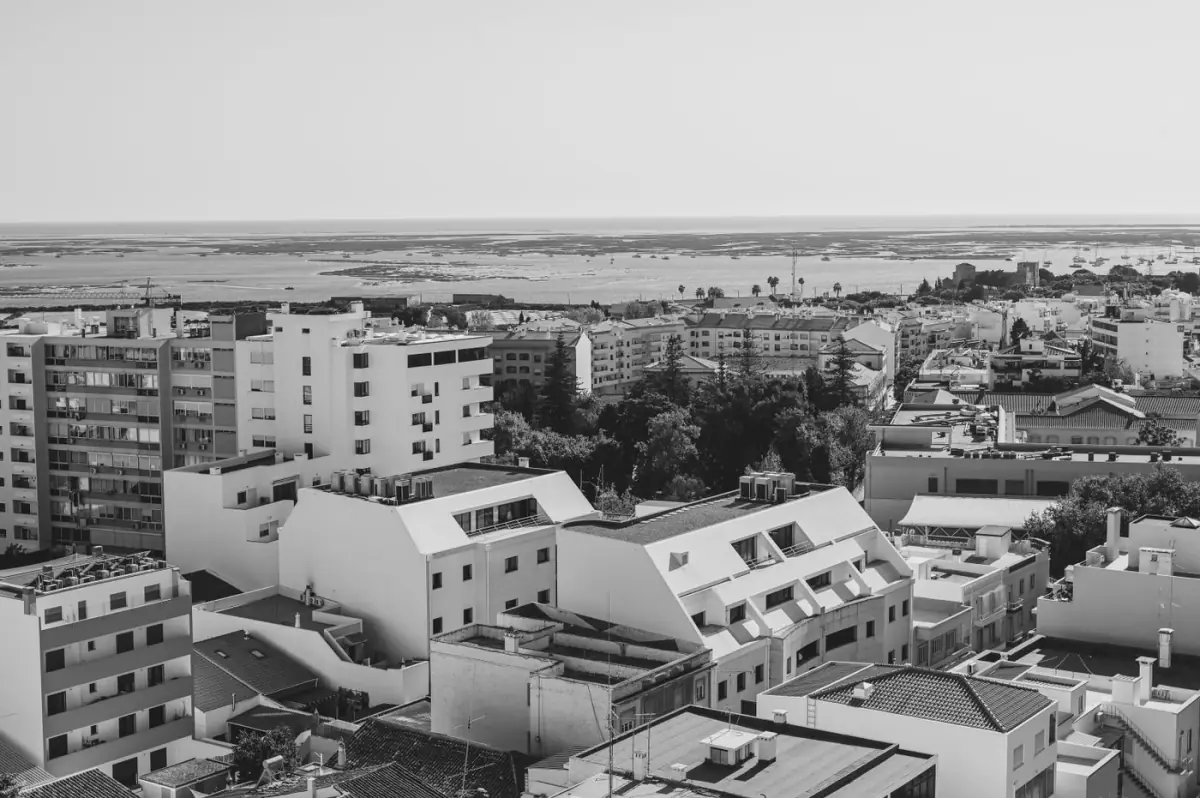
Faro is one of the most practical bases for anyone wanting a holiday with clear sums: it's just 3 km from the airport, it's the district capital and it has the Ria Formosa on its doorstep. For those arriving by plane who want to minimise journeys on the first and last day, staying in Faro avoids long transfers and simplifies the whole trip budget, tourist tax included.
In our inventory, the apartments in Faro are a balanced choice for couples and small families who want to be close to the airport and the city. A 2-bedroom apartment in Faro of around 100 m² comfortably sleeps a family, and there's more than one similar option in the same area, all with direct booking making clear what's in the price.
Real-time availability and prices on Homing — book direct, cheaper than Booking, Airbnb and Hotels.com. Click «See dates and price».
When you book direct, the home's price and the cleaning fee appear added into the total, and the municipal tourist tax — if the municipality charges it — is clearly flagged as payment at check-in. This transparency is what sets booking direct on Homing apart from platforms with commission: you pay what you see, with no service fees appearing at the last step of payment.
If you prefer other areas, the reasoning is the same right across the Algarve. Whether you choose an apartment near Praia da Falésia or a home in the municipality of Tavira, always confirm the municipality's tax and ask for the detail of what's included. With that information in hand, the final price holds no mysteries and comparing options becomes honest.
Sources and references
- Turismo do Algarve (Visit Algarve) — https://www.visitalgarve.pt/
- Câmara Municipal de Faro — https://www.cm-faro.pt/
- Portal ePortugal — Alojamento e taxas — https://eportugal.gov.pt/
- Wikipedia — Algarve — https://pt.wikipedia.org/wiki/Algarve
- Wikipedia — Taxa de dormida (taxa turística) — https://pt.wikipedia.org/wiki/Taxa_tur%C3%ADstica
Original editorial article by Maré Algarve, based on official sources (Turismo do Algarve, ICNF, ABAE/Blue Flag, IPMA, INE) and on our experience of holiday rentals in the Algarve. Prices and availability vary — always check each property's page.