The best time to visit the Algarve depends on what you're after, but the balance of weather, warm sea, price and crowds lands in May, June and September. In July and August the sun is guaranteed (28 °C on average), but it's also when renting a holiday home hits its peak and the beaches fill up. Those who want to pay less book the home early — between three and six months ahead — and avoid the August peak.
When is the best time to visit the Algarve?
For most people the best time is September, with May, June and October close behind. In September the sea is at its warmest of the whole year (21.1 °C), the mean daily maximum is still 26.4 °C, it rains on fewer than two days all month, and there are half as many tropical nights as in August. In other words: the same sea and the same sun as the peak, but with heat you can sleep through and without August prices. If you are tied to the school holidays, August gives you maximum heat — and charges you for it, in the house and on the sand.
The Algarve has one of the mildest climates in Europe, and the official figures back it up: in Faro it rains on an average of 48.9 days a year and the temperature never drops below freezing. That changes the logic of a holiday: unlike many northern destinations, there is "beach weather" here for roughly six months, from May to October. The question stops being "will the weather hold?" and becomes "how much do I want to pay, and with how many people do I want to share the sand?".
So it's worth thinking about the choice across four axes — weather, sea temperature, price and crowds — rather than assuming "summer" is always the best option. It's exactly that cross-reference this month-by-month calendar settles, so you can book your Algarve holiday home in the right week, at the best price.
With such a wide window, the decision stops being seasonal and becomes one of strategy: the same sun and the same sea are available for months, but price and occupancy vary enormously from week to week. That's the ground the following sections map out in detail.
The Algarve month by month: air, sea and rain
The figures below are not estimates. The air data comes from the IPMA climate normals for 1991-2020 at the Faro station, published in 2024; the sea data comes from NOAA's daily sea surface temperature series for two open-water points off the Algarve, from 2015 to 2024. In Faro the mean maximum rises from 16.3 °C in January to 29.4 °C in July. The sea runs from 16.0 °C in March to 21.4 °C in August.
| Month | Air max °C | Sea °C (east) | Sea °C (west) | Rain days |
|---|---|---|---|---|
| January | 16.3 | 17.0 | 16.7 | 6.0 |
| February | 17.0 | 16.1 | 16.1 | 5.4 |
| March | 18.9 | 16.0 | 15.8 | 5.6 |
| April | 20.7 | 17.0 | 16.6 | 5.3 |
| May | 23.5 | 18.4 | 17.5 | 3.8 |
| June | 26.8 | 20.2 | 18.8 | 0.8 |
| July | 29.4 | 21.0 | 19.1 | 0.2 |
| August | 29.2 | 21.4 | 19.0 | 0.2 |
| September | 26.4 | 21.1 | 20.0 | 1.9 |
| October | 23.3 | 21.2 | 20.0 | 6.0 |
| November | 19.6 | 19.6 | 18.8 | 6.6 |
| December | 17.1 | 18.2 | 17.6 | 7.0 |
The table hides the single most useful fact in this guide: the sea does not cool down at the same time as the air. By October the maximum has already dropped to 23.3 °C, yet the water is still 21.2 °C — practically the same as in August. In June it works the other way round: the air is already at 26.8 °C while the sea is still at 20.2 °C. If you are coming to the Algarve to swim, September and October serve you better than June, which is the opposite of what intuition suggests.
The second reading is the rain, and it clears up a common misunderstanding. From June to August an average of 9 mm falls across three months — under 2% of the annual total — with fewer than one rain day per month. But from October to December 221.5 of the yearly 455.1 mm fall: almost half the year's rain in three months. And the wettest month is not January but December, with 90 mm.

With the air, sea and rain figures settled, one detail remains that almost no guide mentions and that changes everything: these numbers are for Faro. A hundred kilometres west, the Algarve is a different place — which is what the next section is about.
💡 Tip: Dolphins Search and Benagil Caves from Albufeira — ★ 4.9 (5,474 reviews) · from €28.8 (affiliate link)
Faro or Sagres: the same Algarve, two climates
IPMA publishes normals for two Algarve stations about 100 km apart: Faro, in the east, and Sagres, at the western tip. Putting them side by side is the most useful thing you can do before fixing dates, because they give different answers to the same question.
| Per year, on average | Faro (east) | Sagres (west) |
|---|---|---|
| Summer days (max ≥ 25 °C) | 115.2 | 57.2 |
| …in August alone | 28.8 of 31 | 16.0 of 31 |
| Very hot days (≥ 35 °C) | 3.1 | 0.6 |
| Tropical nights (min ≥ 20 °C) | 44.7 | 5.8 |
| Rain days | 48.9 | 56.6 |
| Mean annual temperature | 18.2 °C | 17.0 °C |
Faro has twice as many summer days as Sagres: 115.2 a year against 57.2. In August, Faro goes above 25 °C on 28.8 of the 31 days; Sagres on 16.0 — barely more than half the month. This is not a matter of taste but of geography: Sagres takes the Atlantic head-on along with the northerly wind, while the eastern Algarve sits sheltered, already facing the Gulf of Cádiz.
The sea follows the same logic, and in high summer the gap is sharper still: in July and August the eastern side sits around 21 °C and the west around 19 °C. Two degrees look like little on paper, but you feel them as you walk in — and they explain why some people find the Algarve sea freezing and others find it mild, both of them right.
From this comes a rule of thumb. If you are travelling outside the peak — May, June or October — choose the east, where the warmth and the sea last several weeks longer. If you are coming in July or August and extreme heat worries you, the west is naturally cooler: Sagres has 5.8 tropical nights a year against Faro's 44.7. In our own inventory, 36 of 247 houses are in the east and 39 in the west; the large majority — 172 — sit in the centre, which lands halfway on both counts.
Algarve calendar: weather, sea, price and crowds by month
The best combination of weather, warm sea, low price and few crowds falls in September and October, with May close behind. The table below sums up, month by month, what actually decides a holiday: air and sea (official figures, rounded), the rental price level, and how full the beaches and towns are.
| Month | Air °C | Sea °C | Rental price | Crowds |
|---|---|---|---|---|
| January | 16 | 17 | Very low | Empty |
| February | 17 | 16 | Very low | Empty |
| March | 19 | 16 | Low | Quiet |
| April | 21 | 17 | Medium | Rises at Easter |
| May | 24 | 18 | Medium | Calm |
| June | 27 | 20 | Medium-high | Filling up |
| July | 29 | 21 | High | Busy |
| August | 29 | 21 | Peak | Packed |
| September | 26 | 21 | Medium-high | Emptying |
| October | 23 | 21 | Medium | Quiet |
| November | 20 | 20 | Low | Empty |
| December | 17 | 18 | Low | Empty |
Note the pattern: the best months for your wallet and your peace — May, September and October — have a sea as warm as the peak, or warmer, but at mid-season prices. August is the only month with everything at maximum at once: heat, warm sea, prices and people. Anyone with flexibility gains a great deal by sliding a week or two outside that peak, without losing anything essential about a sun holiday.
High, shoulder and low season: what to expect from each?
High season runs from June to September, peaking in July and August; shoulder season covers April, May and October; and low season stretches from November to March. To this division you add a short, intense spike at Holy Week/Easter, which stirs up demand even within shoulder season.
High season (June to September)
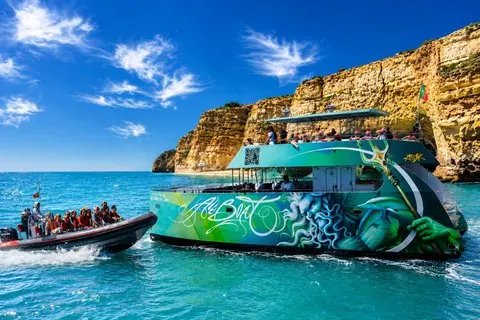
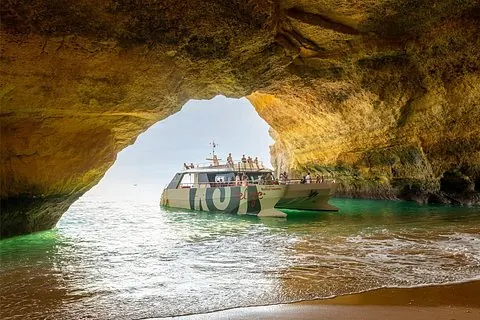
This is the classic summer: long days, highs of 27 to 29 °C, sea at 20–21 °C and full beaches. It is the only time everything runs at full tilt — beach bars, nightlife, ferries to Praia da Ilha de Tavira, boat trips to the Benagil caves. The price is literal: rental prices peak and the good houses sell out months ahead.
Shoulder season (April, May and October)
This is the sweet spot. There is beach weather (especially from May onwards and in October, when the sea is still 21.2 °C), the towns can breathe, and prices drop clearly from the August peak — always check your own dates, because the gap varies a lot from house to house. It is the favourite window for couples, remote workers and families whose children are not yet at school. The most beautiful beaches show themselves without the crowds.
Low season (November to March)
The Algarve does not "close" in winter: the mean maximum stays between 16 and 20 °C and it rains on fewer than seven days a month on average. The sea is cold for swimming — between 16 and 18 °C — but this is the best time to walk the cliffs, play golf, discover Tavira and the Ria Formosa with nobody around, and pay very little for the house. Inland, February brings the almond blossom.
In short, there's no "bad season" in the Algarve — there's the right season for each goal. Knowing these three bands (plus the Easter peak) lets you align your weather and budget expectations before you even look at specific dates.
Recommended tours for this trip
Tours with real traveller reviews, booked on Viator. Most offer free cancellation up to 24 hours before.
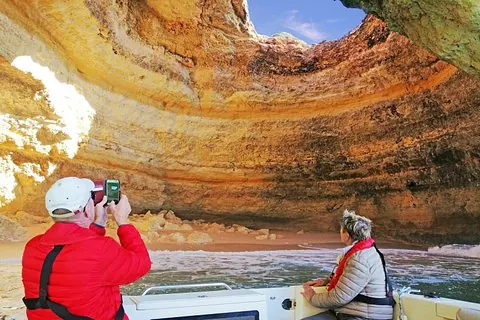 Free cancellationPortimao Benagil Caves Speedboat Tour★ 4.8 (734 reviews) · 1 h 30from €15Check availability
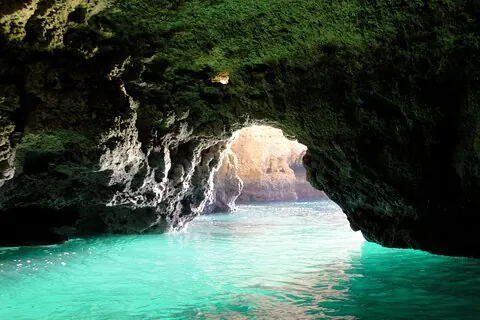 Free cancellationBoat trip to the grottos at Ponta da Piedade, Lagos★ 4.9 (1,523 reviews) · 1 h 15from €20Check availability
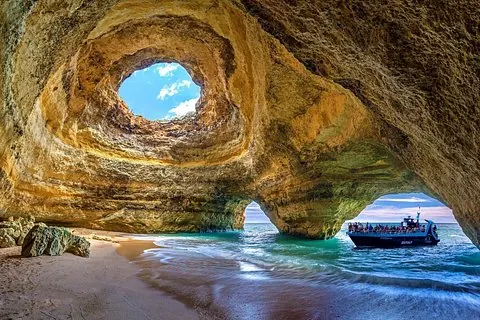 Free cancellationPortimão: Benagil caves and Dolphins • Marine Biologist on board★ 4.8 (828 reviews) · 2 h 30from €34Check availability
Affiliate links: if you book through them, Maré Algarve earns a commission from Viator at no extra cost to you. Indicative prices as of 10/11/2026; the final price is the one on Viator.
When should you book the home to pay less?
To land a good home at a good price, the ideal is to book three to six months ahead — and, if the holiday is in July or August, earlier still. The homes with a private pool, near the beach and with good reviews are the first to sell out for high season, often as early as the winter before. Last minute, in the middle of summer, what's left is scarce and dear.
The logic is that of the airline counter: the closer to the high date, the fewer options and the more expensive. The indicative bands below show the difference between seasons. These are indicative values per night, self-catering, that vary a lot with the dates, how far ahead you book and the length of stay — always confirm on each home's page. They are not our prices, they are a market reference for 2026.
| Type of accommodation | Low season | Shoulder season | High season |
|---|---|---|---|
| Studio | €40–75 | €60–110 | €95–170 |
| 1- to 2-bedroom apartment | €50–95 | €80–150 | €130–240 |
| 2- to 3-bedroom apartment w/ pool | €70–130 | €110–200 | €160–320 |
| 3-bedroom villa w/ private pool | €130–300 | €220–450 | €300–650 |
| 4- to 5-bedroom luxury villa | €250–600 | €450–900 | €700–1800 |
There's one more lever few people use: the booking channel. Booking direct on Homing, our official partner, comes out cheaper than Booking, Airbnb or Hotels.com — there's no platform commission and no hidden fees, and support is in Portuguese, English, French and Spanish. On long stays, that channel difference can be worth several free nights compared with the big platforms.
In other words, paying less in the Algarve is less luck and more method: choosing the right season, booking early, avoiding the Saturday-to-Saturday of August and booking through the direct channel. Those who combine these four decisions often get a better home for less than they'd pay for a worse one at the last minute. See in detail how much it costs to rent a holiday home in the Algarve.
What is the best time according to your goal?
The best time changes depending on what you're after: families with school-age children are tied to July and August, couples and digital nomads gain a lot in May, June, September and October, and those seeking quiet and the lowest price get it right from November to March. There's no single "best month" — there's the best month for you.
Families with school-age children
The real window is July and August, because of the school holidays. Here the advice is simple: book very early (ideally the winter before) a home with a pool and near the beach, and prefer the first week of July or the last of August, where prices already give way. To choose an area, see the best areas of the Algarve for families.
Couples and remote workers
Make the most of the freedom: May, June, September and October give beach, open-air dinners and towns that are alive but not stifled, at shoulder-season prices. September, with the sea at 21 °C and fewer people, is often the best week of the year for two. It's also the ideal moment for a 7-day Algarve itinerary by car.
Those after quiet and the lowest price
From November to March, the Algarve is another place: quiet, cheap and luminous. It's the time for golf, walks in the Ria Formosa, dining with no queues and discovering Olhão or Lagos at the pace of those who live there. Don't count on long swims, but do count on paying a fraction of the summer price.

Defining the goal first — beach in full swing, balance, or quiet and savings — simplifies everything else. From there, this guide's calendar and price bands tell you exactly which weeks to choose and how much to budget for.
Which events and festivals move the prices?
Beyond the season, there are occasional spikes in demand that push prices up unexpectedly: Easter, the long weekends of national holidays and the big summer festivals. Booking before these spikes, or right after, makes a difference to the final bill, even in shoulder season.
- Holy Week/Easter — a short, strong spike in demand, usually in April; prices and availability behave like a mini-high-season.
- Public holidays and bridge days — 25 April, 1 May, 10 June and long weekends fill the coastal towns for a few days.
- Summer festivals — music and food events in July and August raise local demand occasionally in some towns.
- Shellfish and sardine season — the summer culinary peak coincides with the heaviest crowds, above all in the Sotavento.
The effect of these spikes is mainly on availability, more than on rates: on a May bridge weekend, the beach may be pleasant and cheap, but the best homes sell out weeks ahead. The rule is the same as ever — if your dates touch a public holiday or Easter, book before everyone else realises they'll want the same.
It's worth checking the official events calendar with Turismo do Algarve before locking in dates, especially if you want to catch (or avoid) a specific festival. That way you align the buzz you're after with the budget you have.
💡 Tip: Boat trip to the grottos at Ponta da Piedade, Lagos — ★ 4.9 (1,523 reviews) · from €20 (affiliate link)
What's home availability like throughout the year?
Availability is plentiful from October to May and tightens from June, becoming very limited in the top homes in July and August. The best combinations — private pool, near the beach, good reviews — are the first to disappear for high season, often booked as early as winter. So the sooner you decide, the more choice you'll have.
In our inventory, this translates concretely. Albufeira gathers one of the largest offerings in the central Algarve, with around 60 homes just 26 km from Faro Airport, and Lagos, in the Barlavento, pairs postcard beaches with a historic town. They are two ideal bases for those who book early and want to catch the best homes before they sell out.
For a family beach holiday, the apartments with a pool are the most sought-after option — and the first to sell out. Take, for example, the 2-bedroom apartment with private pool in Albufeira (116 m²), the 2-bedroom apartment with pool in Lagos (115 m²) or the 127 m² version in the same town: all combine space, a pool and proximity to the beach, exactly the profile that flies off the shelves in July and August.
Real-time availability and prices on Homing — book direct, cheaper than Booking, Airbnb and Hotels.com. Click «See dates and price».
The reading is clear: availability isn't a problem for most of the year, but it becomes the decisive factor in high season. Booking early, and direct on Homing, secures not only the best price but, above all, the right home — instead of accepting what's left at the last minute. If you're still hesitating between types of accommodation, compare holiday home or hotel in the Algarve.
Frequently asked questions about the best time to visit the Algarve
We've gathered the most common questions from those planning when to go and when to book. The answers follow this guide's calendar and price bands, always with the caveat that the values are indicative and should be confirmed on each home's page.
If your question isn't here, our frequently asked questions page and the where to stay in the Algarve guides cover the rest of the planning details, area by area.
Sources and references
- Turismo do Algarve (Visit Algarve) — https://www.visitalgarve.pt/
- Wikipedia — Algarve — https://pt.wikipedia.org/wiki/Algarve
- IPMA — Normal Climatológica de Faro, 1991-2020 — https://www.ipma.pt/bin/file.data/climate-normal/cn_91-20_FARO.pdf
- IPMA — Normal Climatológica de Sagres, 1991-2020 — https://www.ipma.pt/bin/file.data/climate-normal/cn_91-20_SAGRES.pdf
- NOAA — Optimum Interpolation Sea Surface Temperature (OISST v2.1) — https://www.ncei.noaa.gov/products/optimum-interpolation-sst
Original editorial article by Maré Algarve, based on official sources (Turismo do Algarve, ICNF, ABAE/Blue Flag, IPMA, INE) and on our experience of holiday rentals in the Algarve. Prices and availability vary — always check each property's page.