
The Blue Flag is an international award, granted year by year, that certifies beaches based on bathing water quality, safety with a lifeguard, environmental information and support services. In the Algarve, beaches from all three coastlines — Barlavento, Centro and Sotavento — apply for this award, from the Costa Vicentina to Vila Real de Santo António.
The exact list changes every season, because the award is flown per season and reassessed every year. So this guide shows how the system works, which municipalities to look in and where to stay near the best-served bathing areas, always pointing to the official ABAE list for the final confirmation.
What is the Blue Flag and why does it matter to beachgoers?
The Blue Flag is an international environmental award granted to beaches, marinas and vessels that meet a set of strict criteria. The programme was born in 1987, is coordinated worldwide by the Foundation for Environmental Education (FEE) and, in Portugal, is managed by the ABAE — Associação Bandeira Azul da Europa. When you see the flag flying on a beach, it means that beach has passed an independent annual assessment.
For those planning a holiday, the award works as a shortcut of trust. Instead of guessing whether the water is clean or whether there's supervision, you start from a beach that has had to prove bathing water quality, the presence of a lifeguard during the season and clear information on site. It's especially useful for families with children and for those who don't know the Algarve coast and want to choose without risk.
There's a detail many people don't know: the award is valid only for that year's bathing season. A beach can have a Blue Flag one summer and lose it the next if it stops meeting a criterion — or regain it after fixing the problem. That's why no honest guide can publish a fixed, eternal list; what stays stable is how the system works and the municipalities where more beaches apply.
How many Blue Flag beaches does the Algarve have?
The Algarve is, year after year, one of the Portuguese regions with the most awarded beaches with a Blue Flag, spread across its 14 coastal municipalities and those of the inland near the sea. The exact number is announced by the ABAE at the start of each bathing season, usually between May and June, and can vary from year to year — which is why we don't make up a total here.
The explanation for this concentration is simple: the Algarve lives off beach tourism and the municipalities invest in the facilities the award requires — lifeguard posts, access, cleaning, waste collection and information panels. Municipalities with many urban and semi-urban beaches, such as Albufeira, Portimão and Lagos, tend to present several applications; the same happens in the Sotavento, in Tavira and Vila Real de Santo António.
| Question | What to check |
|---|---|
| Does the beach have a Blue Flag this year? | Check the year's list at bandeiraazul.abae.pt — it changes each season |
| Is it valid all year? | No. It covers the bathing season, with a lifeguard in the defined period |
| Does it guarantee a calm sea? | No. It guarantees supervision and information, not the absence of swell or currents |
| No award means a bad beach? | Not necessarily — many wild beaches don't even apply |
The practical takeaway is this: use the Blue Flag as a starting filter, not as an absolute verdict. To confirm the number and the names for the year you travel, the source is always the ABAE — and cross-checking it with our guide to the most beautiful beaches in the Algarve helps balance beauty, services and proximity to your accommodation.
Which Blue Flag beaches are there in the Barlavento?
In the Barlavento — the western Algarve, from Lagos to Sagres and the Costa Vicentina — applications concentrate on the beaches of municipalities with a strong bathing tradition, such as Lagos, Portimão and Vila do Bispo. This is the land of golden cliffs, caves and the cooler, wilder sea, facing south and west.
Lagos and Praia da Luz
Lagos is usually among the municipalities with a presence on the list, with urban and wide-sand beaches. Meia Praia, with several kilometres of sand, and Praia da Luz, in the parish of Luz, are examples of well-supported bathing areas sought after by families. The town of Lagos sits about 63 km from Faro Airport, which makes it the natural base for the entire far west.
Portimão and Alvor
In Portimão, Praia da Rocha is the calling card: a long stretch of sand, an urban front and every service at hand. The town of Alvor, to the south, brings together the lagoon, the sand and the fishing atmosphere. Portimão sits about 52 km from Faro and concentrates much of the central Barlavento's beach support.
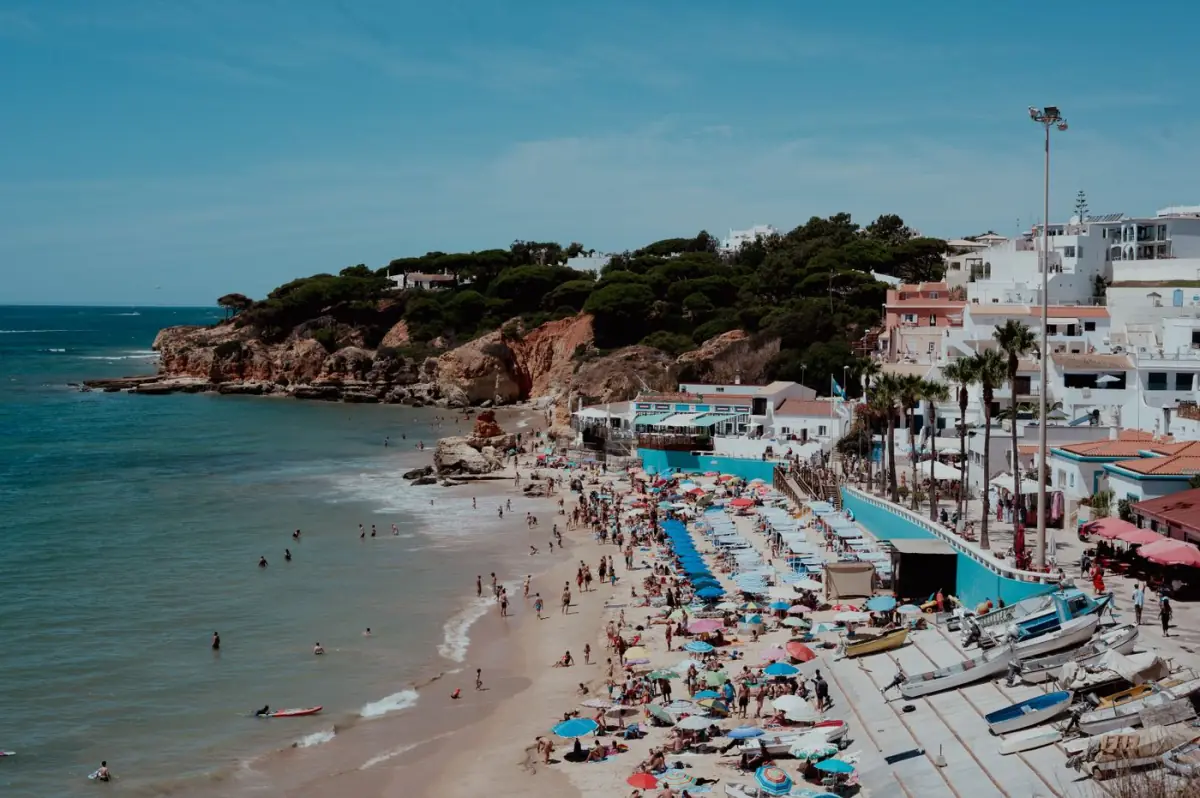
Further west, in Sagres and along the Costa Vicentina, the scene changes: the sea is colder and rougher, and many beaches are wild, without the facilities the award requires. There, the absence of a Blue Flag says nothing about quality — it only says they are beaches left in their natural state, as we explain in the guide to the wild and hidden beaches of the Algarve.
And in the Centro of the Algarve, where are the awarded beaches?
The Centro of the Algarve — from Carvoeiro to Quarteira, by way of Albufeira and the Golden Triangle — is the area with the highest density of urban beaches and, therefore, of those that gather the most Blue Flag applications. It's also the most central region, practical for those who want to combine beach, restaurants and nightlife in the same day.
Albufeira and Galé
Albufeira, with around 44,000 inhabitants and 26 km from Faro Airport, has a long front of urban and semi-urban beaches, from Praia dos Pescadores to Praia da Galé. It's one of the municipalities with the most beach infrastructure in the region, which shows in the ABAE list year after year. To choose an area, it's worth reading the guide on where to stay in Albufeira.
Loulé: Vilamoura, Quarteira and Vale do Lobo
In the municipality of Loulé are some of the best-known sands of the Centro: Praia de Quarteira, Praia da Falésia and the beaches of Vale do Lobo and Ancão, in the Golden Triangle. Vilamoura sits just 15 km from Faro and Quarteira 13 km, which makes this the most accessible area for those arriving by plane who want the beach on the very first day.
Further west, in Carvoeiro and the area of Benagil, the beaches are smaller and tucked into cliffs. They have enormous charm, but not all gather the facilities the award demands — which reinforces the idea that the Blue Flag rewards above all accessible, well-served sandy beaches, and not isolated beauty.
Why does the Sotavento shine on the Blue Flag list?
The Sotavento — the eastern Algarve, from Faro to Vila Real de Santo António — combines two factors that go well with the award: very wide sands and a warmer, calmer sea, sheltered by the barrier islands of the Ria Formosa. It's the ideal coast for families with small children, with beaches where the water rises to 22–24 °C at the peak of summer.
Monte Gordo and Vila Real de Santo António
Monte Gordo has one of the widest sands in the Algarve and a very well-supported seafront, with a lifeguard, access and services — the kind of beach made to fit the Blue Flag criteria. It sits about 49 km from Faro, right by the border with Spain, and is a base much sought after by Portuguese and Spanish families.
Tavira, Santa Luzia and Cabanas
Around Tavira (31 km from Faro), the beaches lie on sand islands and peninsulas of the Ria Formosa, such as Praia da Ilha de Tavira. Access is by boat or by boardwalk, and the sands are immense. The parishes of Santa Luzia and Cabanas de Tavira serve as the gateway to these island beaches.
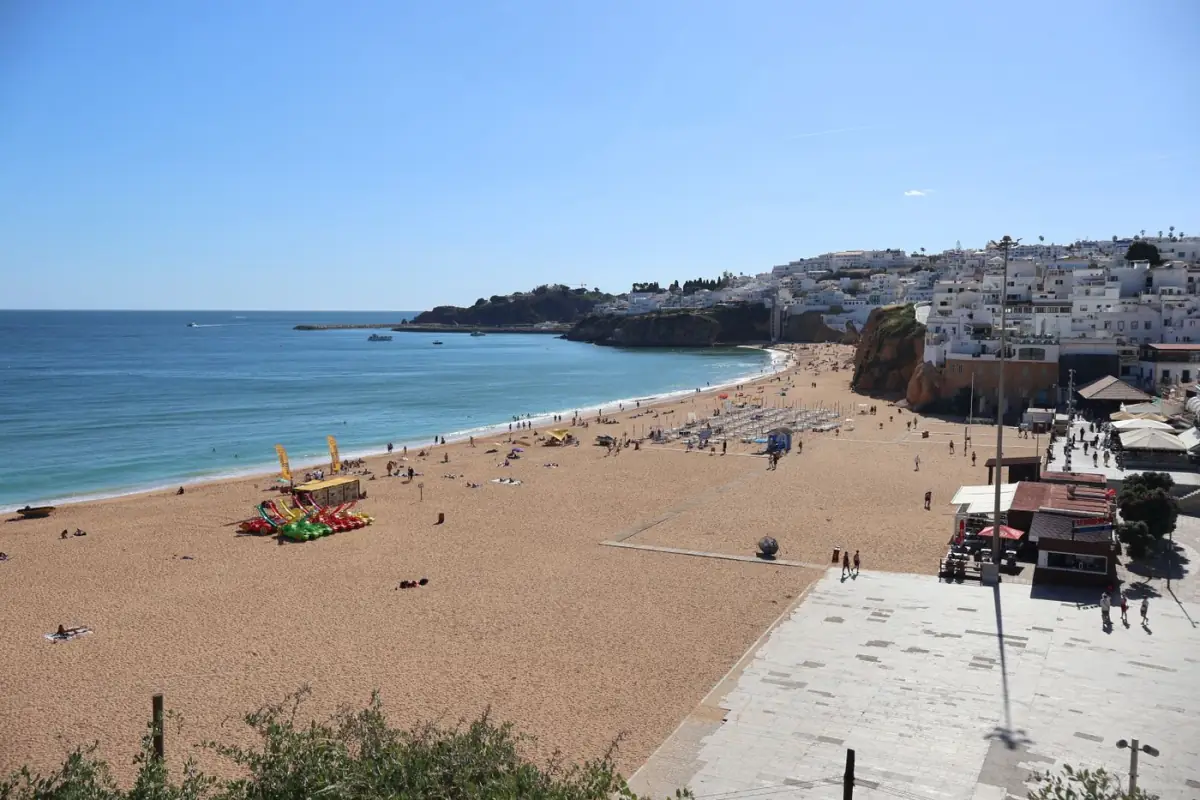
To understand in depth why this side of the Algarve is different — warm sea, oysters, markets and islands — our guide to the authentic Sotavento is worth a read. It's the area that, combining wide sands and a calm sea, best fits the beach profile the Blue Flag tends to reward.
Is the Blue Flag only about water quality?
No. Bathing water quality is only one of the groups of criteria. To fly the flag, a beach must meet around three dozen requirements, spread across four broad areas — and it's that whole set that distinguishes the award from a simple water test.
- Bathing water quality — regular analyses within the excellence parameters required by the European directive
- Safety and services — a lifeguard in season, first-aid equipment, access and emergency plans
- Information and environmental education — panels with water quality, a beach map, rules and awareness actions
- Environmental management — cleaning, selective waste collection, toilets and ordering of the sand
This has an important consequence for the traveller: the Blue Flag tells you the beach is supervised, clean and informed, but not that the sea is calm that day. Currents, swell and temperature change with the weather and the tide. Always respect the coloured flag flown by the lifeguard (green, yellow or red), which signals the real bathing conditions at that moment.
For all this, reading the award as a "seal of a safe, well-managed beach" is more correct than reading it as a "seal of a perfect sea". It's an indicator of management and services, not a promise about the state of the sea hour by hour.
Where to stay near the Blue Flag beaches in the Algarve?
The most practical way to enjoy the awarded beaches is to stay in a rental home a few minutes from the sand, in a town with a good seafront. For the warm-sea Sotavento, Monte Gordo and Quarteira are safe bets; for the lively Centro, Albufeira; for the Barlavento of the cliffs, Lagos and Alvor.
In Monte Gordo, for example, a 2-bedroom apartment a short distance from the sand puts you in front of one of the widest, best-supported beaches in the Sotavento; in Quarteira, a 2-bedroom near the seafront gives you an urban beach and easy access to Vilamoura and the Falésia. These are the kind of bases that make a beach day simple: walk down, stay, come back to lunch at home.
Real-time availability and prices on Homing — book direct, cheaper than Booking, Airbnb and Hotels.com. Click «See dates and price».
Booking these homes is cheaper direct on Homing, our official partner, than on Booking, Airbnb or Hotels.com — with no platform commission or hidden fees, and with support in Portuguese, English, French and Spanish. Rental prices vary a lot with the dates and the lead time, so always confirm the updated price on each home's page.
| Coastline | Base town | Distance to Faro | Beach profile |
|---|---|---|---|
| Sotavento | Monte Gordo | ~49 km | Very wide sand, warm sea, family |
| Centro | Quarteira | ~13 km | Urban beach, near the Falésia and Vilamoura |
| Centro | Albufeira | ~26 km | Lively urban front, several sands |
| Barlavento | Lagos / Alvor | ~63 / 57 km | Wide sands and cliff coves |
Whatever the coastline, the rule is the same: choose first the kind of sea you want — calm and warm to the east, fresher and more scenic to the west — and only then the home. For couples and small groups, the apartments near the seafront are the best value; for larger families, it's worth seeing the options with a pool in our guide to the Algarve with children.
How to confirm and make the most of the Blue Flag list?
The final confirmation should be made on the official ABAE list, published every year at the start of the bathing season. It's the only source that guarantees the right beach for the year you travel, with the current status of the award. Any blog list, including the one in this article, should be cross-checked against that source.
- Check bandeiraazul.abae.pt and filter by the Faro district to see the beaches for the current year
- Cross-check with the distance to your rental home — an awarded beach 30 minutes away pays off less than one 5 minutes away
- Check the supervision period (the Blue Flag is for the bathing season; outside it there may be no lifeguard)
- On the day itself, read the coloured flag at the post before entering the water
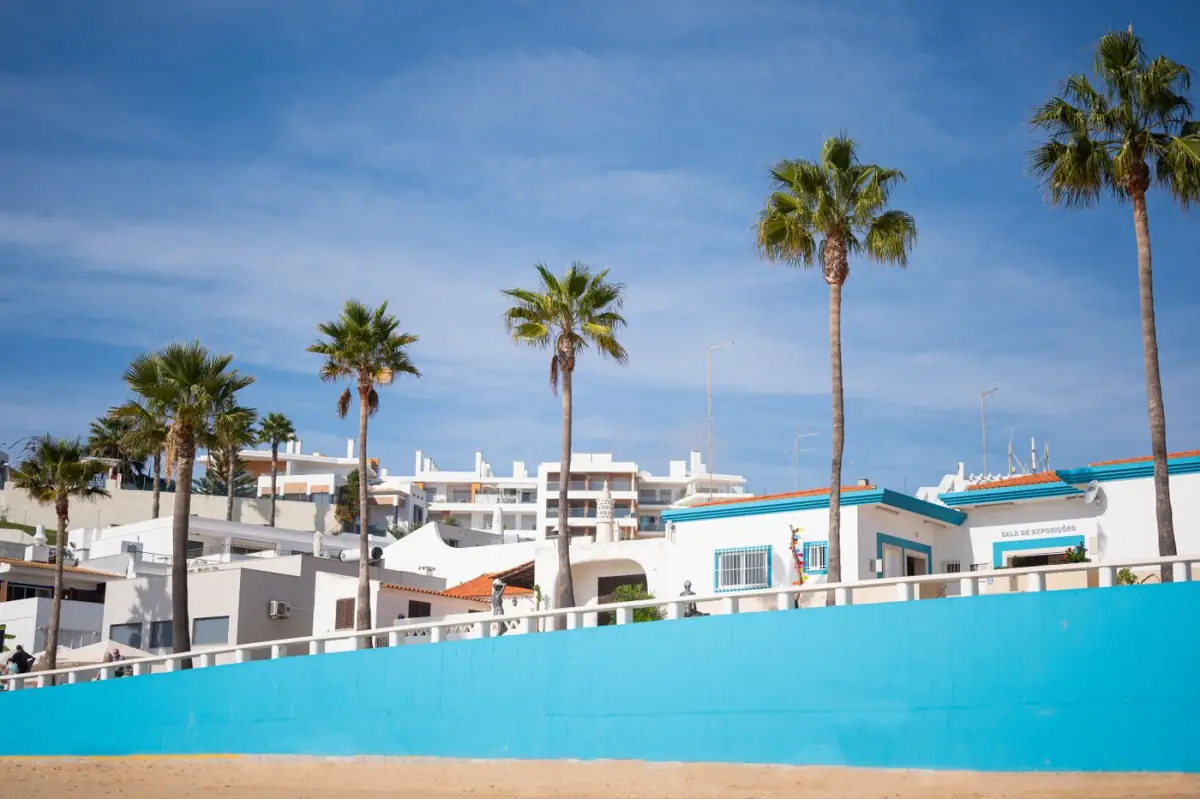
Once this check is done, the Blue Flag becomes a useful planning tool: it helps choose among dozens of beaches, gives confidence to those travelling with children and works well alongside an itinerary. To fit the best beaches into a day-by-day travel plan, combine this guide with our 7-day Algarve itinerary and with the page of all the beaches in the Algarve.
Sources and references
- ABAE — Bandeira Azul (lista oficial) — https://bandeiraazul.abae.pt/
- Foundation for Environmental Education (FEE) — Blue Flag — https://www.blueflag.global/
- Turismo do Algarve (Visit Algarve) — https://www.visitalgarve.pt/
- ICNF — Parque Natural da Ria Formosa — https://www.icnf.pt/
- Wikipedia — Blue Flag — https://pt.wikipedia.org/wiki/Bandeira_Azul
- Wikipedia — Algarve — https://pt.wikipedia.org/wiki/Algarve
Original editorial article by Maré Algarve, based on official sources (Turismo do Algarve, ICNF, ABAE/Blue Flag, IPMA, INE) and on our experience of holiday rentals in the Algarve. Prices and availability vary — always check each property's page.