
Cacela Velha is a tiny village in the municipality of Vila Real de Santo António, in the Sotavento Algarve, perched on a small hill above the Ria Formosa. It comes down to a white church, an eighteenth-century fort and a handful of whitewashed streets, but it's from that rare ensemble that its status as a postcard village is born. It lies about 45 km from Faro Airport and 12 km from Tavira, and its beach can only be reached on foot at low tide or by boat.
Where is Cacela Velha and what makes it different?
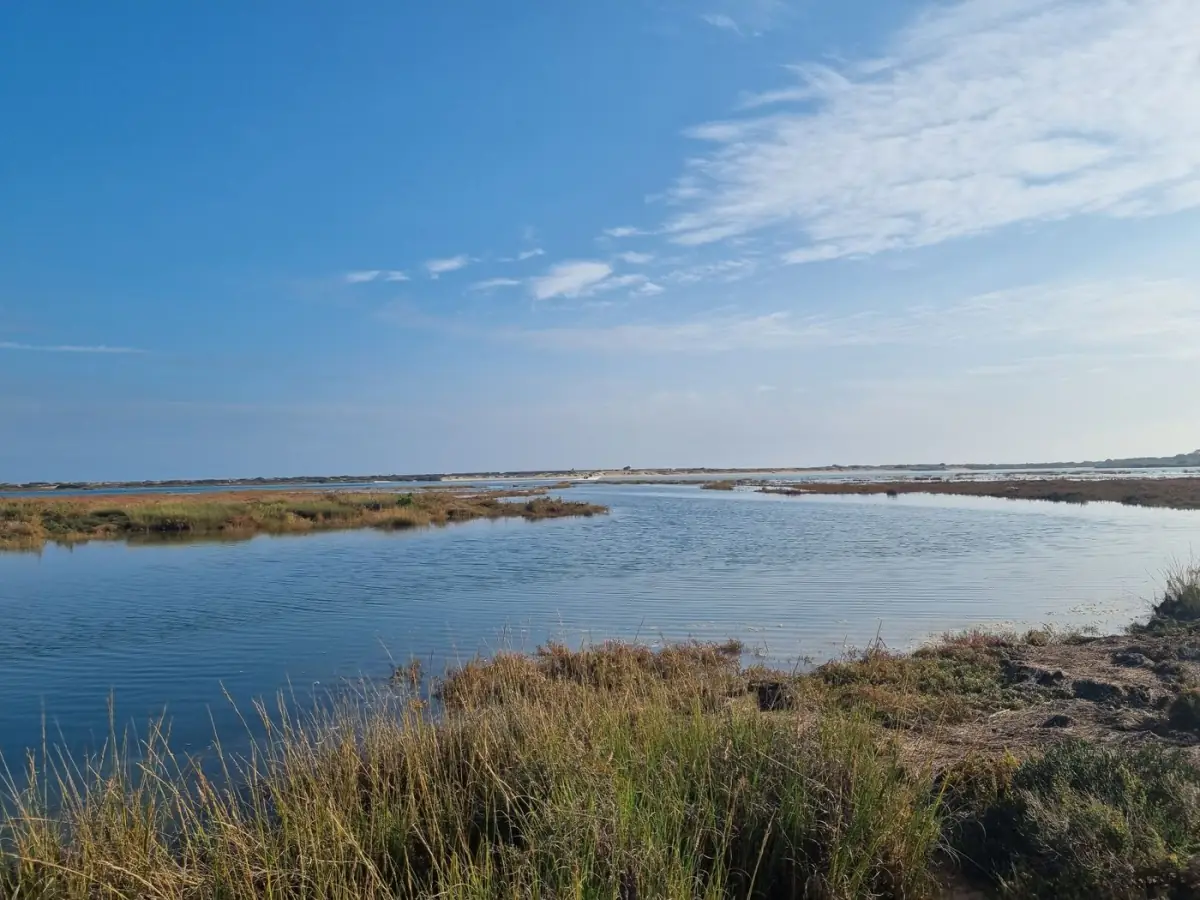
Cacela Velha lies in the Sotavento Algarve, in the parish of Vila Nova de Cacela, municipality of Vila Real de Santo António. It's a very small settlement, with a few dozen permanent inhabitants, set on a spur of land that juts out over the Ria Formosa. What sets it apart is not its size, but its setting: from the square by the church you see the salt marshes, the channels and, in the distance, the tongue of sand that separates it from the open sea.
Unlike the beach towns of the Centre, Cacela Velha was not taken over by high-rise hotels. The houses stayed white and low, with the Church of Nossa Senhora da Assunção and the Cacela Velha Fort closing off the ensemble. That balance between traditional architecture and the lagoon landscape is what places it, year after year, on the lists of the most beautiful villages in the country.
How far is it from the arrival points?
For those planning the trip, the distances are short. Faro Airport is about 45 km away by motorway; Tavira 12 km; Cabanas de Tavira some 8 km; and the Vila Real de Santo António border 20 km. The connection is always best by car, because the nearest bus stop and the Vila Nova de Cacela train station leave you a few minutes from the village square, still with a walk downhill to the viewpoint.
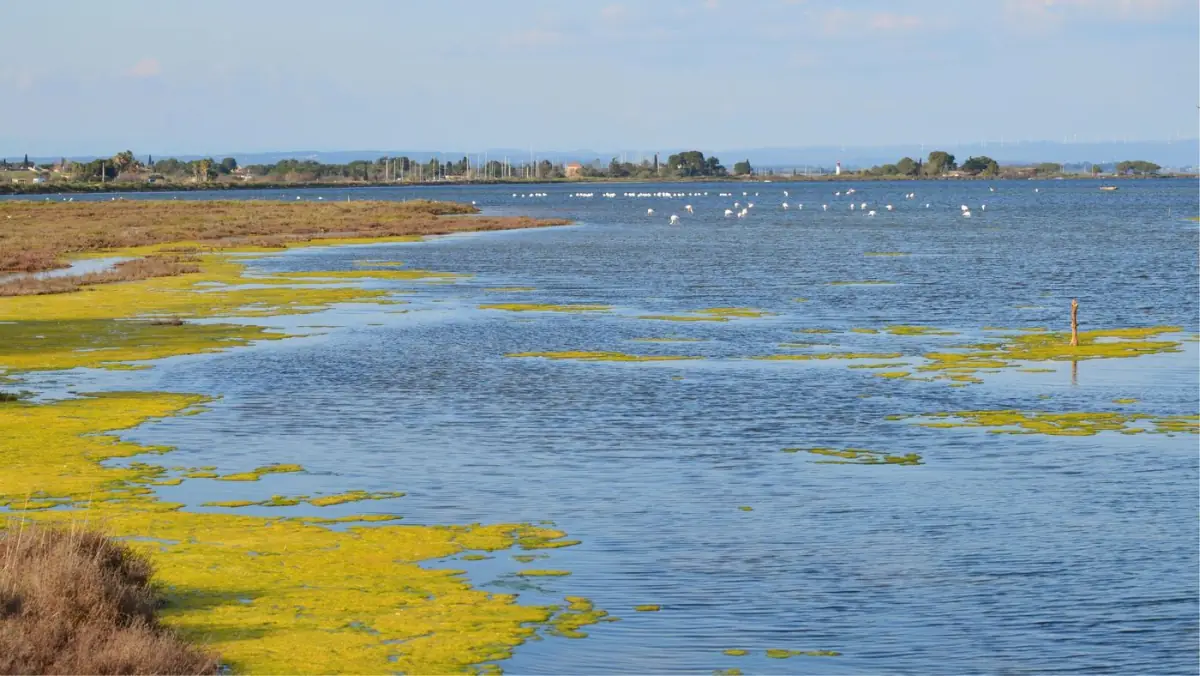
In short: Cacela Velha is a destination to visit, not to stay in. You can see it in two to three hours, but it calls for a base nearby, in Tavira or Cabanas, so you can return to the beach and the oysters without rushing.
How do you reach Cacela Velha beach?
Cacela Velha beach is not right by the village: it lies across the lagoon, on a white-sand spit that forms part of the Ria Formosa system. You reach it from the place called Fábrica, a few minutes by car below the village, in two ways — on foot, crossing the channel when the tide is out, or by water taxi, when the tide rises and covers the passage.
Crossing on foot at low tide
At low tide, a ford of firm sand and waist-deep water forms that you cross on foot in a few minutes. It's the most authentic way to get there, but it takes planning: it's wise to check the day's tide table before heading down to Fábrica, take water shoes and not stay on the beach side when the tide starts to come in, at the risk of having to wait for the boat.
Water taxi from Fábrica
When the tide is high, small boats make the crossing between Fábrica and the sand for a token fee per person, in a few minutes. It's the safe option for families with small children or for those arriving outside the low-tide window. The boats operate mainly during the bathing season; outside it, the service is irregular.
| Access | When | Time | Notes |
|---|---|---|---|
| On foot via the ford | Low tide | 5–10 min | Waist-deep water; water shoes recommended |
| Water taxi | High tide | A few minutes | Paid per person; mainly in high season |
| No car access | — | — | You park at Fábrica and continue on foot or by boat |
The reward for the effort is a beach of fine sand and calm, warm waters on the lagoon side, with the open sea on the other side of the spit. Being within a protected area and dependent on the tide, it stays far less crowded than the Praia do Barril, right next door, in Tavira.
Why are Cacela Velha's oysters so talked about?
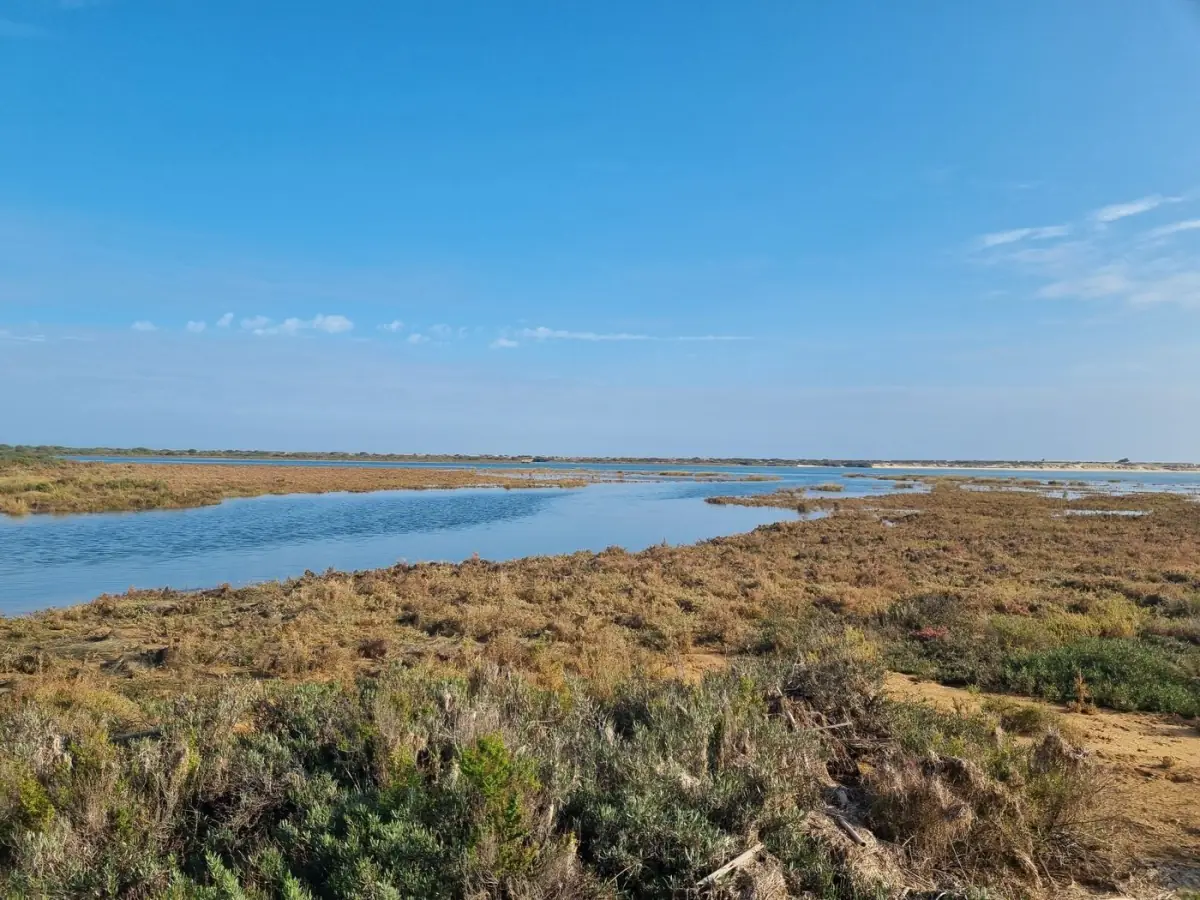
Oysters are the product we most associate with Cacela Velha because they're farmed right there, on the muddy banks of the Ria Formosa that surround the village. The lagoon combines salt water renewed by every tide, shelter and a wealth of nutrients — conditions that make the Sotavento one of the country's hubs for shellfish production. Eating them by the lagoon, with the salt marsh before you, is part of the experience.
Beyond oysters, the Ria Formosa yields clams, wedge shells, cockles and local prawns, which reappear on the menus of the restaurants in Cacela, Fábrica and Cabanas. Anyone who wants to go deeper into the Sotavento table will find a full guide in our where to eat fresh seafood in the Algarve.
It's worth planning the visit around a meal: the village has few seats, fills up quickly on summer weekends, and the quality of the seafood makes booking ahead worthwhile.
What to see in the village: fort, church and viewpoint
The heart of Cacela Velha fits into one square: the Church of Nossa Senhora da Assunção, with its simple white façade, and the Cacela Velha Fort, an eighteenth-century fortification of quadrangular plan that guarded this entrance to the lagoon. Between the two opens the viewpoint that justifies half the visits — a natural balcony over the channels, the salt marshes and the spit.
Cacela Velha Fort
The fort was built in the eighteenth century to defend the coast and the bar. Today it is, above all, the point that frames the view: its low walls serve as a frame for the photograph everyone takes away from the village, with the blue of the lagoon contrasting with the white of the houses.
The whitewashed streets and the rhythm of the village
Beyond the square, Cacela Velha is a handful of narrow cobbled streets, low houses with coloured trims and yards. You can walk it all in twenty minutes, with no traffic, the silence broken only by the birds of the lagoon. It's that human scale — almost a village frozen in time — that contrasts with the marina and resorts of the Golden Triangle to the west.
Because it's so small, the village gains from being combined with other points of the Sotavento on the same day. Tavira, Cabanas and Praia do Barril are all under 15 minutes away, which makes it easy to put together an itinerary of a morning on the lagoon and an afternoon at the beach.
What is the best time of year to visit?
The best months to visit Cacela Velha are May, June and September: the weather is already warm and stable, the lagoon water is warm and the village isn't saturated with visitors as it is in the heart of August. The Sotavento is the most sheltered coast in the Algarve and its water tends to be warmer than the Barlavento's, which comfortably extends the bathing season.
In July and August, the village takes in a lot of people in a few metres and the Fábrica boats work at full hours; those who can should prefer early morning or late afternoon. In winter, Cacela Velha is still worth the visit for the landscape and the birdwatching trips on the lagoon, even if the offer of boats and restaurants shrinks.
Cacela Velha in a handful of hours
- Park in the village square or on the slope; visit the church, the fort and the viewpoint
- Head down to Fábrica and check the day's tide table
- Cross to the beach on foot (low tide) or by water taxi (high tide)
- Come back for a meal of oysters and lagoon seafood
- End the day in Tavira or at Praia do Barril, right next door
This sequence fits into a long afternoon, but most visitors end up wanting to repeat it — reason enough to have the base booked nearby instead of making the round trip on the same day.
Where to stay to visit Cacela Velha?
As the village has practically no tourist accommodation, the practical base for exploring it is Tavira or Cabanas de Tavira, both 10–15 minutes away by car. Tavira offers the historic centre, more restaurants and a connection to Tavira Island; Cabanas is quieter and sits right by the lagoon, with a waterside boardwalk — ideal for those who want to wake up already inside the lagoon setting.
In our inventory, the Sotavento appears above all in well-located apartments, which work well for couples and small families. A three-bedroom apartment in Tavira, with 91 m², gives room to a family that wants to be near the centre; in Cabanas, a two-bedroom apartment with pool of around 100 m² combines the quiet of the lagoon with the convenience of a dip at the door. For couples, a two-bedroom with pool in Tavira, of 108 m², balances space and price.
Real-time availability and prices on Homing — book direct, cheaper than Booking, Airbnb and Hotels.com. Click «See dates and price».
All these homes are booked direct on Homing, our official partner — cheaper than Booking, Airbnb and Hotels.com, with no platform commission and no hidden fees, with support in Portuguese, English, French and Spanish. The prices shown on each listing are indicative and vary with the dates — confirm on each home's page.
Those hesitating between municipalities can compare the picture in the where to stay in the Algarve guide and go deeper into the region in our guide to the authentic Sotavento. For the homes themselves, the starting point is the search for homes page.
How to combine Cacela Velha with the rest of the Sotavento?
Cacela Velha pays off more when it's a stop within a Sotavento itinerary, and not an end in itself. In half a day, it easily joins up with Praia do Barril and its anchor cemetery, to the west; over a full day, you add the historic centre of Tavira and a trip along the lagoon channels.
- Lagoon morning: viewpoint and fort of Cacela Velha, then the beach via the ford or by boat
- Seafood lunch: oysters and clams at Fábrica or in Cabanas
- Town afternoon: Tavira — bridges, churches and Tavira Island
- Nearby beaches: Praia da Ilha de Tavira and Praia de Monte Gordo
Further east, still in the same municipality, Vila Real de Santo António and Monte Gordo offer wide sands and the border with Spain. To the west, Olhão opens the door to the barrier islands of the Ria Formosa. With the base well chosen, this whole eastern side of the Algarve is within reach of short daily trips.
Is Cacela Velha worth it? The verdict
Cacela Velha is clearly worth it for those seeking the most serene and photogenic Algarve, far from the marinas and the resorts. It's not an easy-access beach destination nor a nightlife one; it's a place of landscape, of seafood and of silence. Those who arrive expecting shops and entertainment leave disappointed; those who come for the lagoon, the oysters and the white against the blue leave wanting to return.
The key to enjoying it is to treat it as the jewel of a larger necklace — the Sotavento — and settle into a home in Tavira or Cabanas, a few minutes away. Book early, above all for July and August, because the inventory on this side of the Algarve is scarcer than the Centre's and sells out first on the most sought-after dates.
At heart, Cacela Velha is proof that the Algarve still keeps places of small scale and strong character. With tide planning and a good home nearby, it turns into the best half-afternoon of a whole holiday in the Sotavento.
Sources and references
- Turismo do Algarve (Visit Algarve) — https://www.visitalgarve.pt/
- ICNF — Parque Natural da Ria Formosa — https://www.icnf.pt/
- Wikipédia — Cacela Velha — https://pt.wikipedia.org/wiki/Cacela_Velha
- Wikipédia — Ria Formosa — https://pt.wikipedia.org/wiki/Ria_Formosa
- Município de Vila Real de Santo António — https://www.cm-vrsa.pt/
Original editorial article by Maré Algarve, based on official sources (Turismo do Algarve, ICNF, ABAE/Blue Flag, IPMA, INE) and on our experience of holiday rentals in the Algarve. Prices and availability vary — always check each property's page.