
Praia do Barril is a barrier-island beach in the municipality of Tavira, about 7 km from the historic centre and 31 km from Faro Airport. It forms part of the Ria Formosa Natural Park and stands out for the anchor cemetery, dozens of iron anchors driven into the sand beside the dunes, and for the little train that links the Pedras d'el Rei entrance to the seafront.
Access is by a wooden boardwalk over the salt marsh; by car you stop at Pedras d'el Rei and the rest of the way is on foot (about 1 km) or on the tourist train. It's one of the widest and quietest beaches in the Sotavento, with a sea warmer than the Barlavento and pale sand stretching for kilometres.
Where is Praia do Barril and what does it belong to?
Praia do Barril lies on a barrier island off Santa Luzia, in the municipality of Tavira, within the Ria Formosa Natural Park. As the crow flies it's a few kilometres from the centre of Tavira, but the real access goes through Pedras d'el Rei, a resort village west of the town, and across a boardwalk that crosses the salt marsh to the ocean-facing sand.
This is an island beach of the Ria Formosa, in the Sotavento Algarve. The barrier of islands and peninsulas that shields the lagoon stretches from Faro to Cacela Velha, and the Barril is the stretch of Tavira Island easiest to visit without a boat. Facing the open sea and sheltered by the lagoon at its back, it has wide sand on one side and channels and salt marsh on the other.
The nearest village is Santa Luzia, with around 1,589 inhabitants, known as the octopus capital. A few minutes away is Tavira, the historic town of the municipality, which serves as the gateway for those arriving by car or by train. To frame the whole area, our guide to Tavira brings together beaches, restaurants and where to stay.
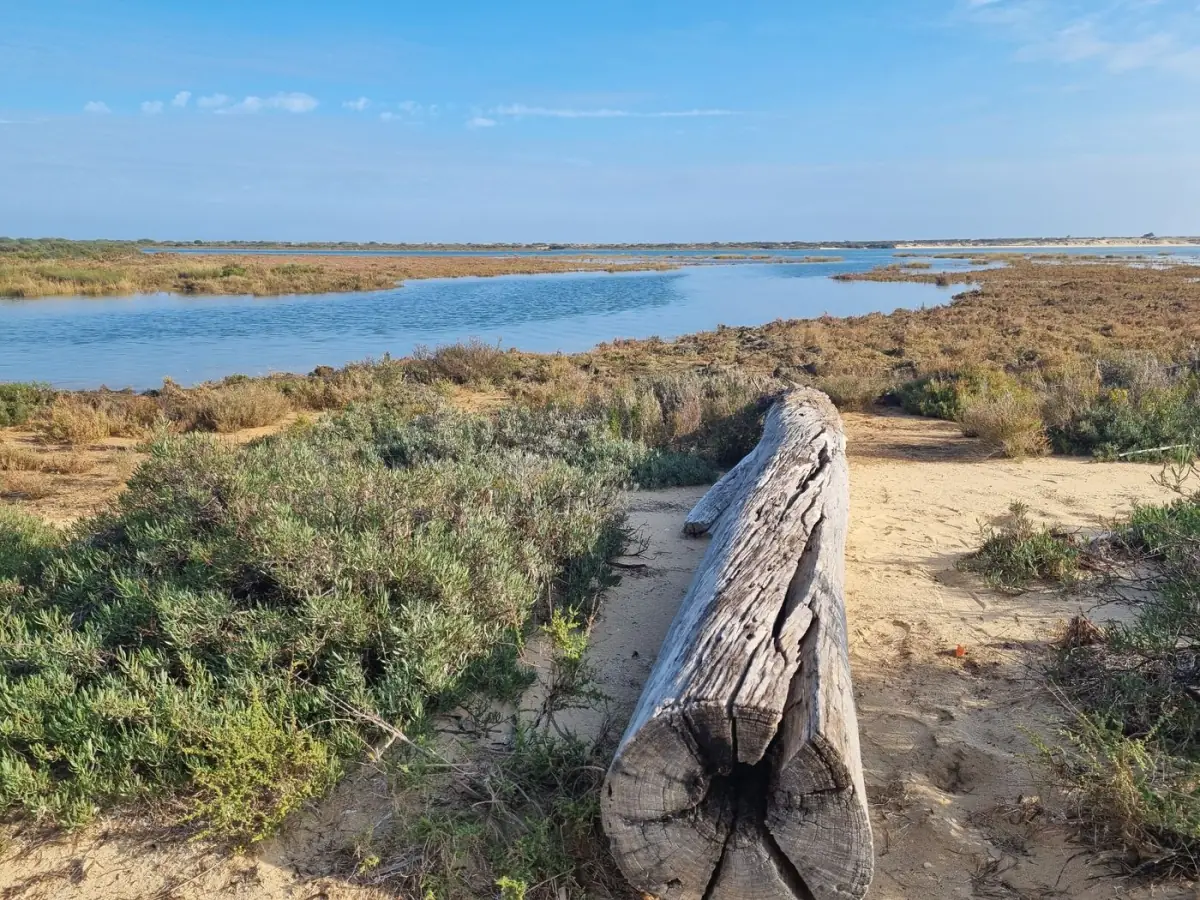
That walk over the salt marsh is part of the experience: as you cross, you see the lagoon, the shellfish beds and, at the right tide, herons and flamingos. So the Barril also works as a gateway to understanding the Ria Formosa up close, and not just as a bathing beach.
How do you reach Praia do Barril from Tavira?
To reach Praia do Barril you park at Pedras d'el Rei and walk about 1 km along the boardwalk, or take the little tourist train that runs that stretch. By car from the centre of Tavira it's about 10 minutes to the car park; from Santa Luzia it's even closer. There's no direct car access to the sand — the last kilometre is always on foot or by train.
The Pedras d'el Rei train
The Barril train is a classic: a small tourist set linking the car park to the seafront, crossing the salt marsh. It runs above all in the bathing season and is handy for families with children, pushchairs or for those who prefer to save the walk in the heat. On foot, the same flat route takes 10 to 15 minutes.
From Tavira without a car
Without a car, the simplest option is to take a taxi or local bus from Tavira to Santa Luzia or Pedras d'el Rei and continue on foot or by train. In high season there are also boat connections from Tavira and Santa Luzia to the islands of the Ria Formosa, although the Barril is, above all, the beach with pedestrian access. Those arriving by plane will find Faro Airport about 31 km from Tavira.
| Departure point | Distance to the entrance (Pedras d'el Rei) | Way to reach the sand |
|---|---|---|
| Santa Luzia | about 2 km | On foot/by car to Pedras d'el Rei + boardwalk or train |
| Centre of Tavira | about 7 km | Car/taxi to Pedras d'el Rei + boardwalk or train |
| Faro Airport | about 31 km | Car to Tavira/Pedras d'el Rei + last km on foot or by train |
Whatever the starting point, the scheme is always the same: you reach Pedras d'el Rei and cover the last stretch on foot or by train. So staying in Tavira or Santa Luzia shortens the journey a lot and avoids wasting time in high-season traffic.
What is the anchor cemetery?
The anchor cemetery is a set of dozens of iron anchors driven into the sand beside the dunes of the Barril, laid out in rows that climb up through the vegetation. They are anchors from the old tuna fishing rigs, fixed nets set out off this coast when the tuna passed on migration. When that fishery ended, the anchors stayed, and the sand turned into an open-air memorial.
Pedras d'el Rei and the Barril were, in their day, a fishing settlement tied to that activity. The buildings that supported the old rig still stand beside the sand, today converted into bars and beach-support areas. The whole gives the Barril a character few Algarve beaches have: as well as being a bathing beach, it's a place of memory of the sea economy of the Sotavento.
It's worth setting aside ten minutes to climb up to the anchors before choosing your spot on the beach. It's one of the reasons the Barril makes almost every list of unusual Algarve beaches, even though it's easy to reach.
What are the sand and the sea of the Barril like?
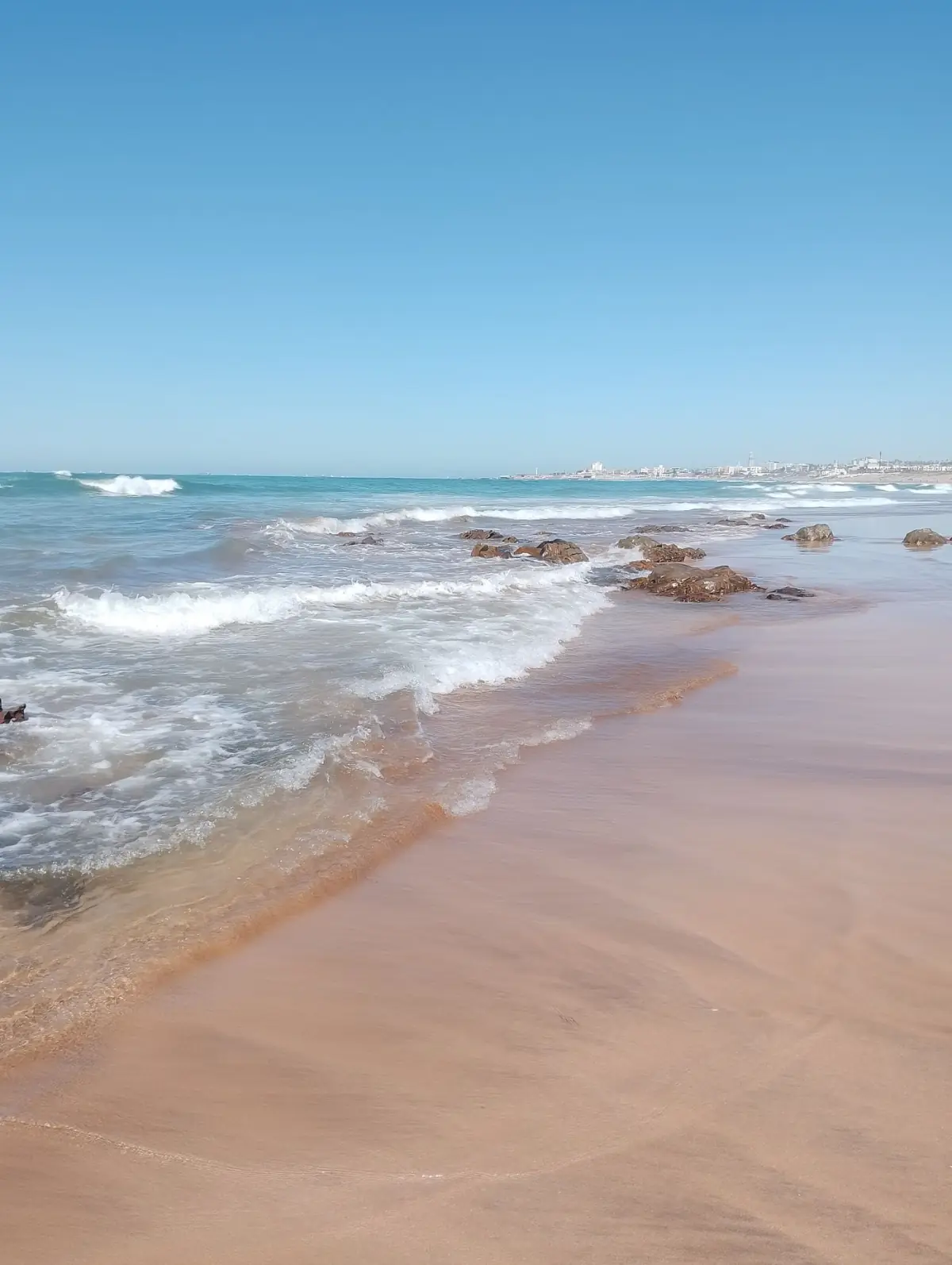
The sand of the Barril is wide, long and pale, with dunes behind and the open sea in front. Being a barrier-island beach, it stretches for kilometres and rarely gets as crowded as the urban beaches of the Barlavento. The sea is that of the Sotavento: tending to be warmer and calmer than on the Lagos and Sagres side, with a sandy bottom and a gentle entry.
This combination of vast sand, mild sea and few rocks makes the Barril a comfortable beach for families and for those who want to walk along the shore. Those after waves and cliffs should instead look to the Costa Vicentina, with a far more rugged profile than the flat, open sand of the Sotavento.
Beach support and what to bring
On the seafront there are bars and restaurants set up in the old rig buildings, so you don't have to bring everything from home. Even so, it's wise to bring water, a hat and sun protection, above all because natural shade is scarce on the dunes. As the final access is always on foot or by train, it pays to travel light and leave the heavier cool box for destinations with parking by the sea.
- Comfortable footwear for the boardwalk and the soft sand by the dunes
- Water and sun protection, since shade is scarce
- Cash/phone for the train and the support bars
- Light clothing, because the last stretch is always on foot or by train
With the essentials in hand, the roughly one-kilometre walk pays off with wide, peaceful sand, far from the bustle of the urban beaches. For those who prefer to have the car right by the sea, there are other options in the Sotavento, but few offer this balance of space and quiet.
What is the best time to visit Praia do Barril?
The best time to visit the Barril runs from May to October, with the water warmest between July and September. At the height of summer the beach takes in a lot of people and the train fills up, so the ideal is to arrive early. In June and September you get sun, a mild sea and far more space on the sand, with the salt marsh painting itself different colours depending on the season.
Out of the bathing season, the Barril changes character: the train reduces its operation, but the boardwalk is still walked on foot and the beach takes on an almost deserted feel, great for winter walks and for birdwatching on the Ria Formosa. Those considering coming at that time will find tips in our article on the Algarve off-season.
It's also worth keeping an eye on the tides. At low tide, the sand becomes immense and the pools by the rocks turn into proper aquariums for children to explore; at high tide, the strip of dry sand shortens. It pays to check the day's tide table before deciding the time of your visit.
What to see around: Santa Luzia, Tavira and the Ria Formosa
Around the Barril there's much beyond the sand. Santa Luzia, the village at the entrance, is Portugal's octopus capital and lives off fishing: strolling along the waterfront and lunching on octopus at a restaurant facing the lagoon is almost obligatory. Tavira, a few minutes away, offers a historic centre with churches, the Roman bridge, the castle and cobbled streets that justify half a day's visit.
All around is the Ria Formosa, with its channels, bivalve beds and barrier islands. Those who want to go further can take a boat to the other islands of the Ria Formosa or drive to Cacela Velha, the village perched over the lagoon east of Tavira. For the general context of the region, the guide to the Sotavento helps connect the dots between Tavira, Olhão and the lagoon.
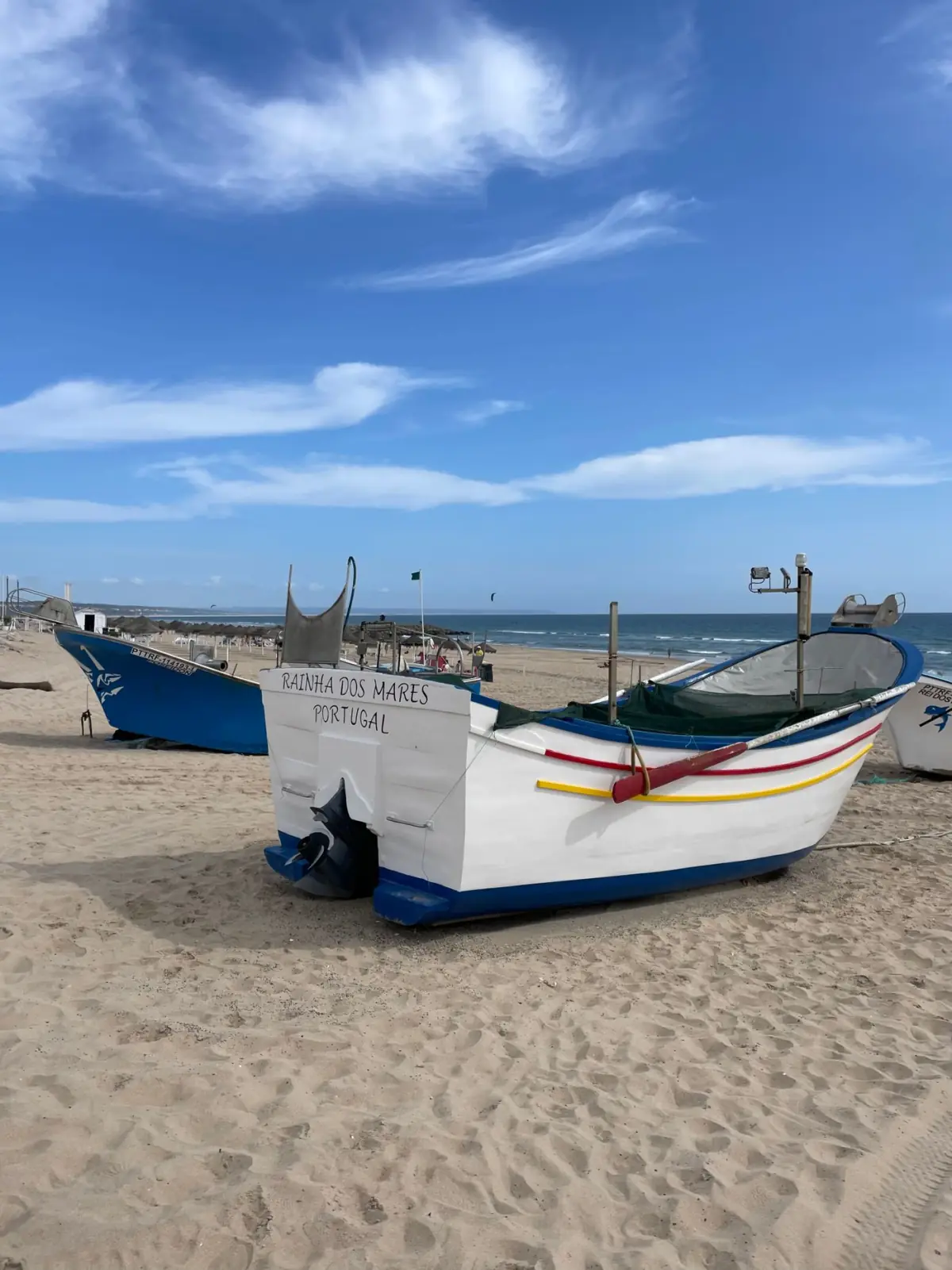
This closeness between island beach, fishing village and historic town is what sets the Tavira area apart in the Algarve landscape. With only a few kilometres separating each point, it's possible to combine beach and cultural heritage in the same day, without long journeys.
Where to stay near Praia do Barril?
To stay near Praia do Barril, the two natural bases are Santa Luzia and Tavira. Santa Luzia puts you a few minutes from Pedras d'el Rei and the beach access, in a calm fishing setting; Tavira gives more choice of restaurants, shops and historic-town life, with the beach still 10 minutes away by car. Both sit about 30 km from Faro Airport.
In our inventory in Tavira and Santa Luzia there are mainly apartments and villas of family management, many with a pool. For couples or small families, the 2-bedroom apartment with private pool in Santa Luzia of 60 m² is practical for a stay by the lagoon; those needing more space can look at the 3-bedroom apartment in Tavira of 91 m², a short distance from the centre, or the 2-bedroom apartment with pool in Tavira of 108 m², among the most spacious in the area.
Real-time availability and prices on Homing — book direct, cheaper than Booking, Airbnb and Hotels.com. Click «See dates and price».
These homes are booked directly on Homing, our official partner, which usually comes out cheaper than Booking, Airbnb or Hotels.com by charging no platform commission or hidden fees, with support in Portuguese, English, French and Spanish. The rates vary with the dates — always check on each home's page before booking.
If you're still hesitating between types and areas, the guide where to stay in the Algarve and the article on direct booking vs Booking and Airbnb help you decide calmly. For the specific area, start with the Tavira hub and see the available homes.
Praia do Barril or other Sotavento beaches?
The choice between the Barril and the other Sotavento beaches depends on the kind of day you're after. The Barril brings together easy access, wide sand and the anchor cemetery in a single spot, which makes it a good first beach for those staying in Tavira. For variety, the neighbouring islands and Cacela Velha offer different settings a few kilometres away.
| Beach | Access | Character |
|---|---|---|
| Praia do Barril | On foot or by train from Pedras d'el Rei | Wide sand, anchor cemetery, ideal for families |
| Tavira Island | Boat from Tavira/Santa Luzia | Livelier island beach in high season |
| Cacela Velha | On foot/by boat to the sand below the village | Lagoon and salt marsh, tucked-away and wild setting |
In practice, many visitors combine them: a day at the Barril for the ease and the scenery of the anchors, another by boat to Tavira Island or by car to Cacela. For an overview of the region's best beaches, see our guide to the best beaches in the Algarve, which helps you put together the week's beach itinerary.
Sources and references
- Turismo do Algarve — Visit Algarve — https://www.visitalgarve.pt/
- ICNF — Parque Natural da Ria Formosa — https://www.icnf.pt/
- Câmara Municipal de Tavira — https://www.cm-tavira.pt/
- Wikipédia — Tavira — https://pt.wikipedia.org/wiki/Tavira
- Wikipédia — Ria Formosa — https://pt.wikipedia.org/wiki/Ria_Formosa
- IPMA — Instituto Português do Mar e da Atmosfera — https://www.ipma.pt/
Original editorial article by Maré Algarve, based on official sources (Turismo do Algarve, ICNF, ABAE/Blue Flag, IPMA, INE) and on our experience of holiday rentals in the Algarve. Prices and availability vary — always check each property's page.