
Sagres is the south-western tip of the Algarve, in the municipality of Vila do Bispo, about 87 km from Faro Airport. It's the wild side of the region: high cliffs, constant Atlantic swell and beaches within the Southwest Alentejo and Vicentine Coast Natural Park, a protected area that stretches north as far as Aljezur and Odeceixe. Those after busy blue-flag beaches and seafront bars have come to the wrong destination; those after surf, wind, nature and silence have come to the right place.
What is Sagres and why is it so different from the rest of the Algarve?
Sagres is a town in the municipality of Vila do Bispo, on the south-western tip of the Barlavento, and marks the point where the Algarve stops being mild and turns Atlantic. While the southern coast, facing the calm sea, gives sheltered beaches like Praia da Marinha or Praia de Dona Ana, Sagres is exposed to two coasts at once: to the south, calmer, and to the west, the Costa Vicentina, battered by the swell and the north wind.
That double exposure explains everything. The sea is colder and rougher, the wind blows almost every day and the landscape is one of bare cliffs, low scrub and an open horizon. It's the opposite of the resort Algarve. Here there's no marina, no championship golf, no crowds of Praia da Rocha; there are surfers, walkers, couples in search of peace and people who prefer a sandwich on a plain terrace to a cocktail bar.
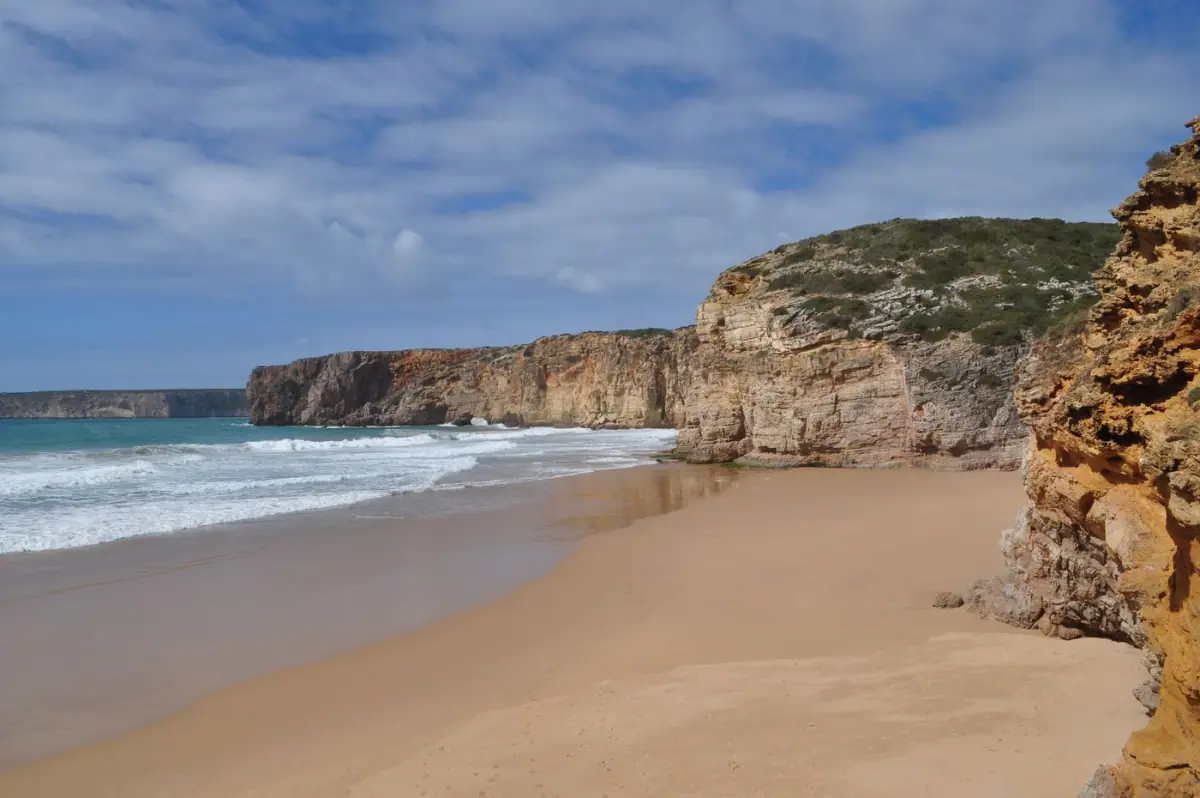
Geographically, Sagres is part of a world of its own that maps call the Costa Vicentina and which extends north through Aljezur and Praia da Arrifana as far as Odeceixe, on the border with the Alentejo. It's a stretch of protected coastline, with building held back and beaches that still look like what they were fifty years ago. For those arriving used to the central Algarve postcard, the shock is real — and welcome.
How do you get to Sagres and how long does it take?
By car, Sagres is about 87 km from Faro Airport, or roughly 1h15 via the A22 motorway (Via do Infante) to Lagos and then the N125. It's the inhabited point furthest from the airport in the whole Algarve, which helps explain why it stays so little overrun. Those coming from Lagos (63 km from Faro) take about 35 to 40 minutes to reach Sagres.
Your own car is practically obligatory in this area. There are buses linking Lagos to Sagres and Vila do Bispo, but the wild beaches of the Costa Vicentina, the trails and Cape St Vincent are off the beaten track and without frequent public transport. Without a car, you're at the mercy of timetables and miss half of what makes this coast special. Our guide on how to get to and around the Algarve details the options.
| Destination | Distance (km) | Driving time |
|---|---|---|
| Lagos | 63 km | ~50 min |
| Praia da Luz | 68 km | ~55 min |
| Aljezur | 81 km | ~1h05 |
| Odeceixe | 85 km | ~1h10 |
| Sagres | 87 km | ~1h15 |
These distances change how you plan. Sagres isn't a morning day-trip destination; it's a place to stay two or three days, or to use Lagos as a base and make forays. Book the car rental ahead, especially in August, because demand in the western area surges and prices rise with the dates.
Is Cape St Vincent and the fortress worth visiting?
Yes — Cape St Vincent is the most south-westerly point of continental Europe and has the most powerful land lighthouse on the continent, visible dozens of kilometres out to sea. It sits about 6 km from the town of Sagres, on a cliff headland where the Atlantic beats with almost constant force. It's the classic spot to watch the sun plunge into the ocean, in the very place where the ancients thought the world ended.
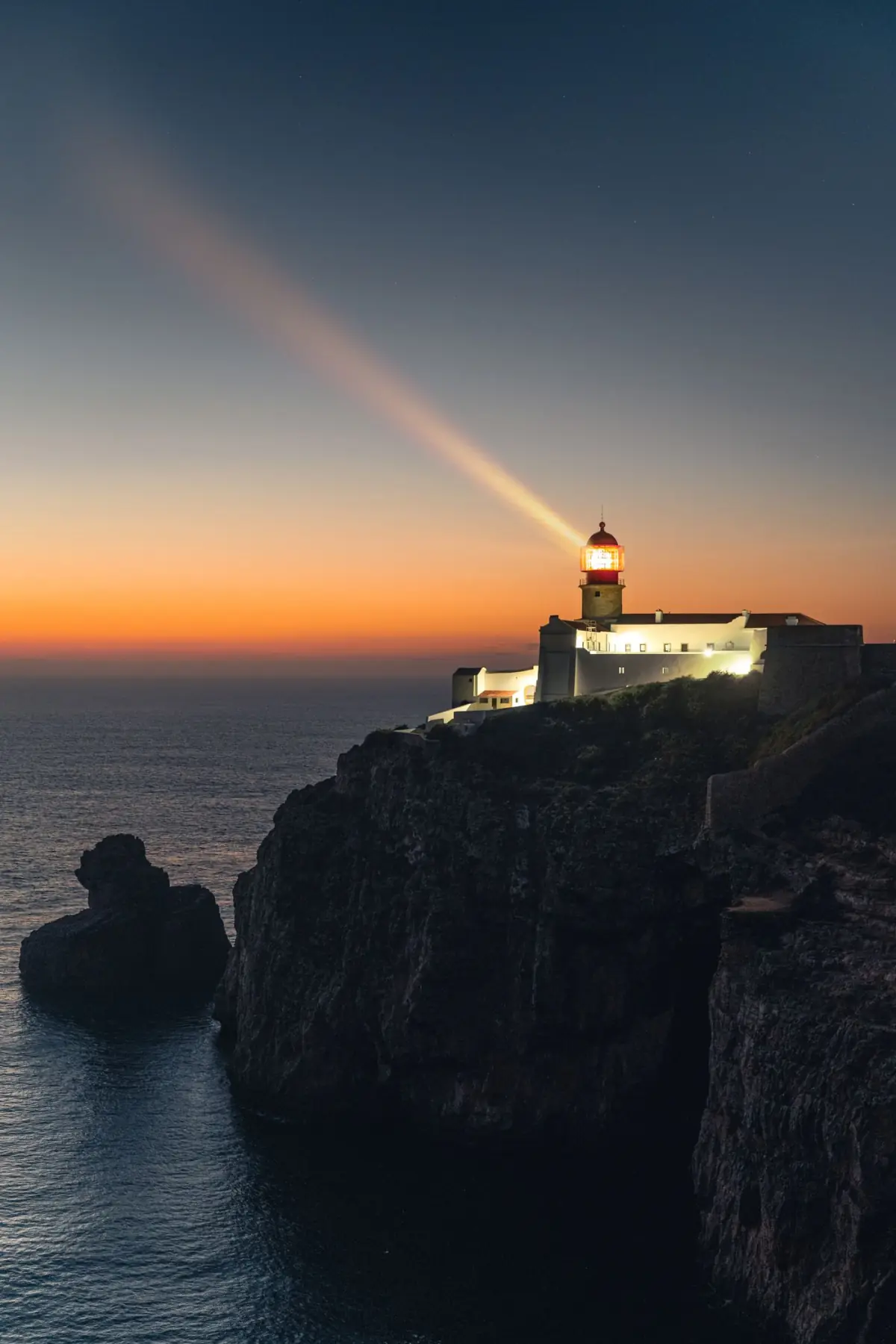
A few minutes away, within the town itself, stands the Fortress of Sagres, tied to the memory of Henry the Navigator and the navigation school of the Discoveries. Inside, the huge wind rose drawn on the ground stands out. Entry is paid and the grounds are vast, with paths over the cliff and views in all directions. Even those who don't care for history come away impressed by the scale of the landscape.
A practical warning: the wind at the cape and the fortress can be brutal, even in high summer. Bring a windproof jacket, hold on tight to hats and phones near the cliffs and never go near the edges, which have no protection and are unstable. The sunset fills the car park at dusk, so arrive with time to spare if you want a space.
What are the best wild beaches of the Costa Vicentina?
The best wild beaches are on the Sagres–Carrapateira–Aljezur–Odeceixe axis, all within the Southwest Alentejo and Vicentine Coast Natural Park. They are beaches of pale sand, high cliffs and few facilities, often battered by swell and wind. Praia do Amado, in Carrapateira, and Praia da Arrifana, in Aljezur, are the best known and among the most beautiful in the whole region.
Next to Sagres, the Mareta and Tonel beaches are the most accessible: the Mareta, facing south, is more sheltered and better for family bathing; the Tonel, exposed to the west, is surfers' territory. Further north, Praia do Castelejo and Praia da Cordoama, near Vila do Bispo, offer wide sands beneath dark cliffs, with few people outside the August peaks.
- Praia da Mareta (Sagres) — facing south, calmer, good for families and the closest to the town.
- Praia do Tonel (Sagres) — exposed to the west, strong swell, a classic surf spot.
- Praia do Amado (Carrapateira) — a huge stretch of sand, surf schools, open landscape.
- Praia da Arrifana (Aljezur) — a bay sheltered by cliffs, one of the most photogenic in the west.
- Praia do Castelejo and Cordoama (Vila do Bispo) — wide sands, dark cliffs, wind and few crowds.
Before going into the water, respect the flags and the warnings: many of these beaches have strong currents and unsupervised areas. The tides shift the available sand a great deal, especially at the Tonel and the Arrifana, where high tide can swallow almost the whole beach. If you want more ideas of this kind, our guide to wild and hidden beaches of the Algarve goes deeper into dozens of stretches of sand away from the crowds.
Where do you find the best surf in Sagres and Aljezur?
Sagres and Aljezur are the heart of Algarve surf, thanks to the Atlantic exposure that guarantees waves almost all year round at different beaches. The big advantage of the area is the variety: with two coasts and several spots close by, there's nearly always a beach working, whatever the wind or the swell direction. That's why the area concentrates so many schools and so many surf camps.
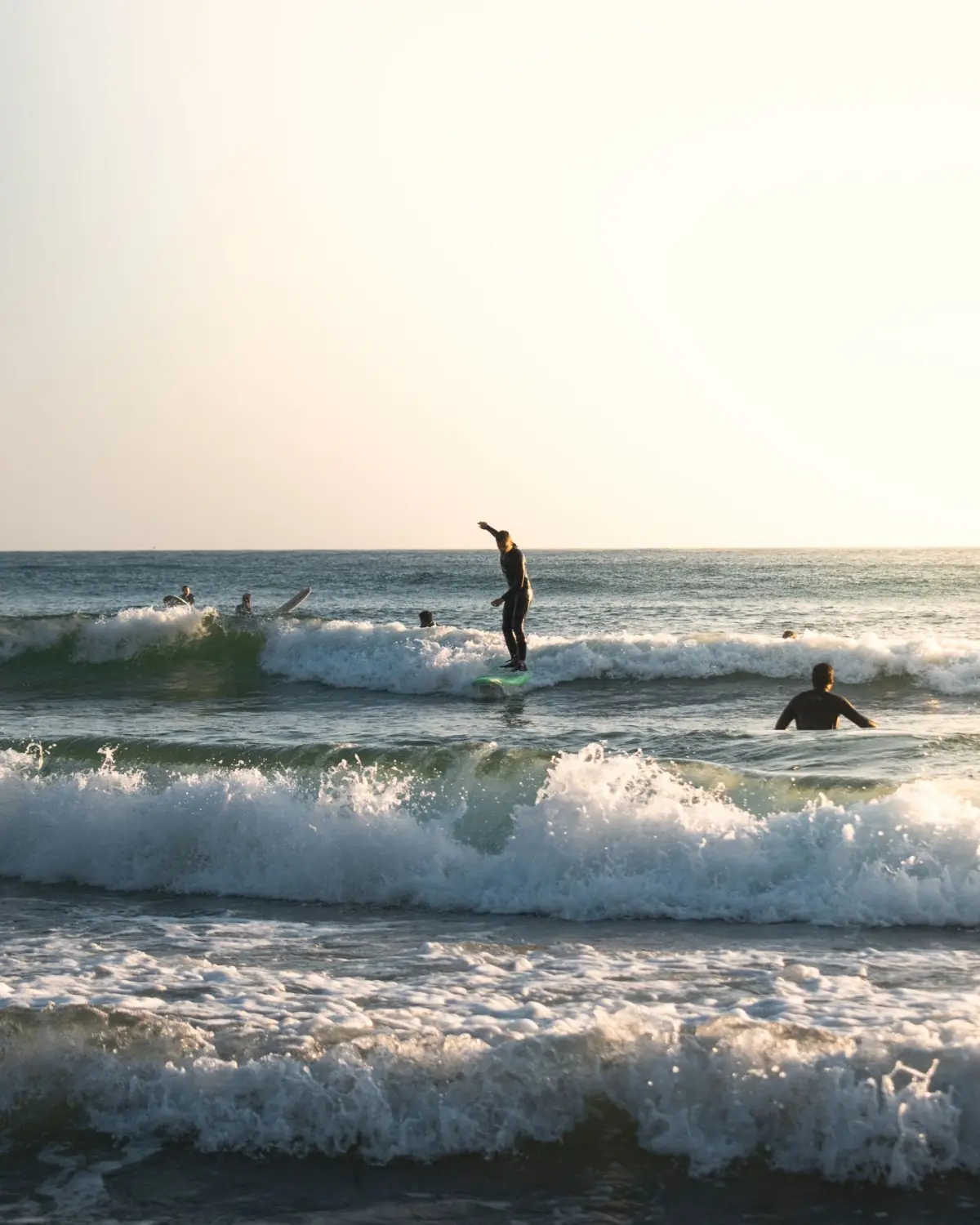
For beginners, Praia do Amado and Praia da Arrifana are the natural choices: sandy bottoms, more orderly waves in certain conditions and schools with lessons for beginners, including children. For experienced surfers, the Tonel, the Beliche and the Castelejo spots offer more serious waves when the swell fills in. Aljezur, in particular, has become a small surf hub, with accommodation, schools and a young atmosphere.
An honest piece of advice: the Atlantic on this coast is cold, even in July and August, because of the upwelling of deep waters. Always count on a wetsuit, which the schools provide. And if you want to compare spots by difficulty level across the whole region, see our guide to the best surf beaches in the Algarve by level.
What to see in the Southwest Natural Park and on the trails?
The Southwest Alentejo and Vicentine Coast Natural Park is a protected area managed by the ICNF that covers this whole coastal strip and is one of the best walking destinations in Portugal. This is where the Rota Vicentina runs, a network of long-distance trails that follows the coast between cliffs, dunes and almost deserted beaches. The Fishermen's Trail, the most coastal part of the route, is the most spectacular: you walk right on the edge of the cliff, with the Atlantic always in view.
Spring is the best time for the trails, when the scrub blooms and the temperatures are mild. In summer, walk at the start of the morning or late in the afternoon, bring water and sun protection, because there's little shade along the coast. The biodiversity is remarkable: seabirds, storks that nest on rocky ledges over the sea and endemic flora found nowhere else.
Beyond the walking, it's worth driving the road between Sagres and Carrapateira, stopping at the viewpoints over the cliffs, and visiting the small town of Aljezur with its castle. To plan specific routes, our guide to trails and walks in the Algarve brings together routes from the Seven Hanging Valleys to the Rota Vicentina.
Is Sagres for you? Surfers, couples and nature lovers
Sagres and the Costa Vicentina serve three very clear profiles: surfers, couples after calm and lovers of the outdoors. For them, it's one of the best places in the country. For families with small children who only want a sheltered beach and entertainment, or for those who want nightlife and restaurants on every corner, there are far more convenient areas of the Algarve.
For surfers
It's the king destination. Waves all year, dozens of spots, schools, surf camps and an active community between Sagres and Aljezur. Add the wind, which also draws bodyboarders and wind-sports enthusiasts. Anyone who surfs becomes naturally captive to this coast.
For couples
It works very well for those who want to disconnect. Sunset at Cape St Vincent, unpretentious dinners of fresh fish, walks for two and beaches where you hear the sea and little else. It's romantic in a rugged way, not in a spa-and-champagne way — for that, see our guide the Algarve for couples.
For families with children
Possible, with caveats. Praia da Mareta, sheltered, is good for children, but the sea is cold and most of the Costa Vicentina beaches have swell and currents that call for care. Families who want more comfort find better conditions further east; our guide the Algarve with children compares areas with them in mind.
The common thread is simple: if you want the wild Atlantic, space and nature, Sagres is hard to beat. If you want warm sea, the shade of a parasol and a bar to hand, you'll feel the lack of things — and perhaps Lagos or the central Algarve will suit you better.
Where to stay in Sagres and around: the practical base
Sagres itself has limited accommodation and, on our network, there's no inventory of homes in the town; the nearest practical base with a good offer is Lagos, about 35–40 minutes' drive away. Lagos combines the best of both worlds: a city with life, restaurants and famous beaches like Praia do Camilo and Praia de Dona Ana, and it's close enough to visit Sagres, Cape St Vincent and the Costa Vicentina beaches without being isolated.
Those wanting even more quiet can choose Praia da Luz, a small, peaceful town west of Lagos, great for couples and families who prefer calm. For groups and larger families, a spacious family home in Lagos sorts the accommodation and gives the freedom to explore the west at your own pace. All of this is booked directly on Homing, with no platform commission and cheaper than Booking, Airbnb or Hotels.com.
Real homes to use as a western base
In our selection, the 1-bedroom apartment in Praia da Luz is ideal for a couple who want the Atlantic and quiet a few kilometres from Sagres. For groups, the 5-bedroom family home in Lagos, with almost 500 m², accommodates large families or surf groups with room to spare. And there are also two 3-bedroom apartments with a pool in Lagos that balance comfort and price for those using the city as a starting point.
Real-time availability and prices on Homing — book direct, cheaper than Booking, Airbnb and Hotels.com. Click «See dates and price».
Whatever the choice, book early: the offer in the western Barlavento is smaller than in the central Algarve and sells out fast in summer. Always confirm dates, capacity and what's included on each home's page, and use our guide where to stay in Lagos to choose the right area within the city.
When to go and how much it costs: climate, wind and budget
The best time for Sagres depends on the aim: May, June and September give the best balance of good weather, fewer people and more reasonable prices. Summer is cool by Algarve standards — the wind and the cold sea keep temperatures pleasant when the rest of the region bakes in the heat. For surf, autumn and winter bring the best swell, with fewer crowds and much lower accommodation prices.
The wind is the factor that most surprises new arrivals. In Sagres it blows almost always, especially in the afternoon, which is great for cooling off and for wind sports, but it can bother those who only want to sunbathe quietly on the sand. South-facing beaches, like the Mareta, are more sheltered on days of north wind.
In terms of cost, this is a cheaper area than the Golden Triangle, but the rental offer is smaller and concentrated in Lagos and around. The bands vary a lot with the dates — always confirm on each home's page. To plan the overall budget of the holiday, our guide how much it costs to rent a holiday home in the Algarve and the one on when to book a holiday in the Algarve help you catch the best dates. Booking directly on Homing, with no commission, is the final step to spend less.
Sources and references
- ICNF — Southwest Alentejo and Vicentine Coast Natural Park — https://www.icnf.pt/
- Turismo do Algarve (Visit Algarve) — https://www.visitalgarve.pt/
- Rota Vicentina — https://rotavicentina.com/
- IPMA — Portuguese Institute for Sea and Atmosphere — https://www.ipma.pt/
- Wikipedia — Cape St Vincent — https://pt.wikipedia.org/wiki/Cabo_de_S%C3%A3o_Vicente
- Wikipedia — Sagres — https://pt.wikipedia.org/wiki/Sagres_(Vila_do_Bispo)
Original editorial article by Maré Algarve, based on official sources (Turismo do Algarve, ICNF, ABAE/Blue Flag, IPMA, INE) and on our experience of holiday rentals in the Algarve. Prices and availability vary — always check each property's page.