
Praia da Amoreira sits at the mouth of the Aljezur stream, in the municipality of Aljezur, within the Natural Park of the Southwest Alentejo and Costa Vicentina. It's a double beach: on one side, the river forms a shallow lagoon of calmer, milder water; on the other, the Atlantic pounds with strong swell. Aljezur sits about 81 km from Faro Airport, at the north-western tip of the Algarve.
It's one of the few beaches in the region where you can have the kids splashing in the arm of river while, twenty metres away, the surfers catch waves on the open sea. That contrast is the reason for this guide.
Where is Praia da Amoreira and what makes it different?
Praia da Amoreira sits on the west coast of the municipality of Barlavento, next to the village of Aljezur, at the mouth of the Aljezur stream. What sets it apart is the geography: the stream meets the sea exactly here, and instead of flowing out at a single point, it spreads into a wide lagoon over the sand before reaching the Atlantic. The result is a beach with two water environments side by side.
Aljezur is a small, rural municipality — it has about 5,884 inhabitants and lives largely off the sea, agriculture (the famous Aljezur sweet potato) and nature tourism. The village sits about 81 km from Faro Airport, which puts it among the most distant points of the Algarve from the airport. That distance is, in part, what keeps the Amoreira less busy than urban beaches such as Praia da Rocha.
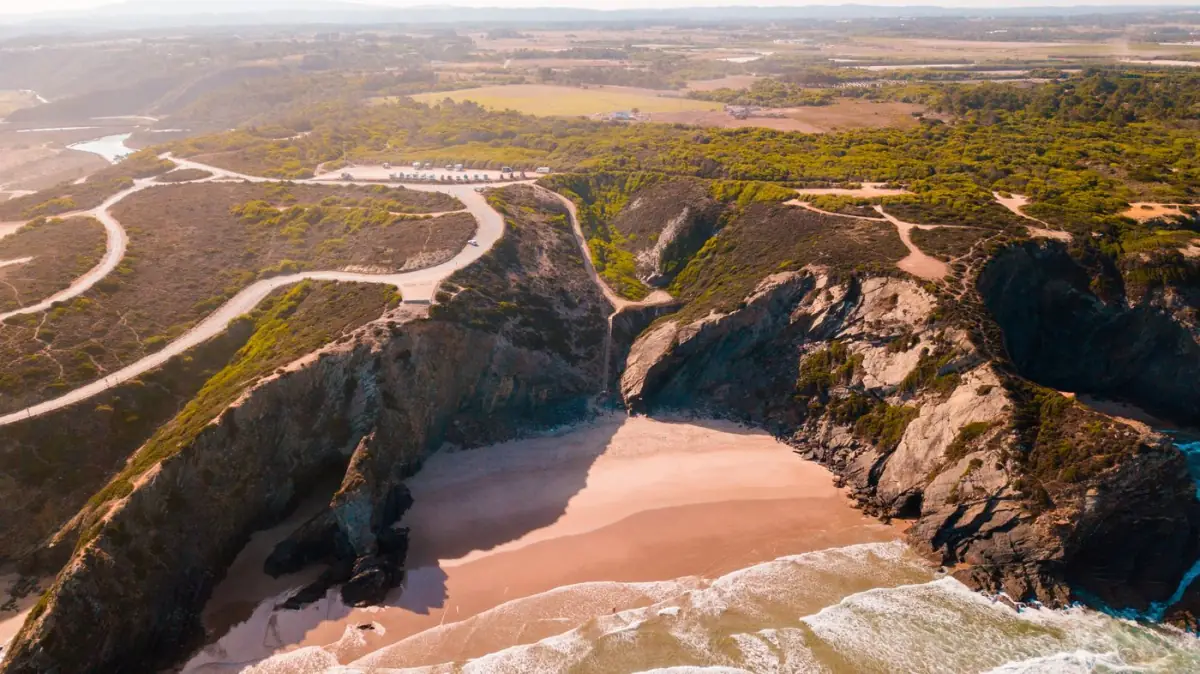
This whole strip belongs to the Natural Park of the Southwest Alentejo and Costa Vicentina, managed by the ICNF. That explains the absence of large developments: building is limited, the dunes are protected and access to the sand is by wooden boardwalks, so as not to tread on the dune vegetation. It's a wild coast, of cold winters and summers of morning fog, very different from the warm-sea Sotavento.
Is the Amoreira a river beach or a sea beach?
It's both, and that's its main feature. The Aljezur stream forms, before reaching the Atlantic, a shallow lagoon of calmer and milder water than the ocean. That arm of river is what makes the Amoreira so sought after by families: the children play in shallow water with no swell, while the open sea is reserved for those after waves.
The river side (lagoon)
The lagoon changes shape over the year and with the tides. At low tide, it gains sandbanks and small channels you can wade across; at high tide, it fills up and draws closer to the sea. The river water is generally warmer than the Atlantic because it's shallower and warms in the sun. It's the natural spot for those travelling with babies or young children.
The sea side (Atlantic)
On the ocean side, the Amoreira is pure Atlantic: consistent swell, currents and cold water all year round. The flags and the seasonal lifeguard show where it's safe to enter. For relaxed bathing with children, the river always wins; for surf, bodyboarding and quick dips, it's the sea that counts. Knowing how to tell the two sides apart before entering the water is half the way to a calm day.
How do you reach Praia da Amoreira by car?
You reach the Amoreira almost necessarily by car — public transport to the Aljezur coast is scarce and the beach lies outside the village. From Faro Airport, count on about 81 km to Aljezur and a few more kilometres by local road to the river mouth, where there's a dirt car park next to the sand.
| Departure point | Distance | Approximate time |
|---|---|---|
| Faro Airport | ~81 km | 1h15–1h30 |
| Lagos | ~50 km | 45–55 min |
| Sagres | ~40 km | 40–45 min |
| Odeceixe | ~15 km | 15–20 min |
| Portimão | ~60 km | 55–65 min |
The distances and times vary with summer traffic and with the state of the local roads, which near the coast are narrow. If you're coming from Lagos or from Portimão, the trip is a good excuse to discover Sagres and the Costa Vicentina along the way. It's wise to arrive early on summer days, because the car park is limited and fills up by mid-morning.
Is Praia da Amoreira good for surf?
Yes — the Amoreira is one of the surf beaches on the Aljezur coast, suited above all to intermediate and advanced surfers. The sandy bottom and the Atlantic swell generate quality waves when the sea and the wind line up, but the currents demand respect and experience. It's not the best option for the first lesson of a lifetime.
Those starting from scratch usually have a better experience on beaches with schools and more controlled areas. The Aljezur and Vila do Bispo coast concentrates much of the Algarve's surf, with Praia da Arrifana and Praia do Amado among the best known for lessons and for all levels. The Amoreira fits into this same string of surf beaches.
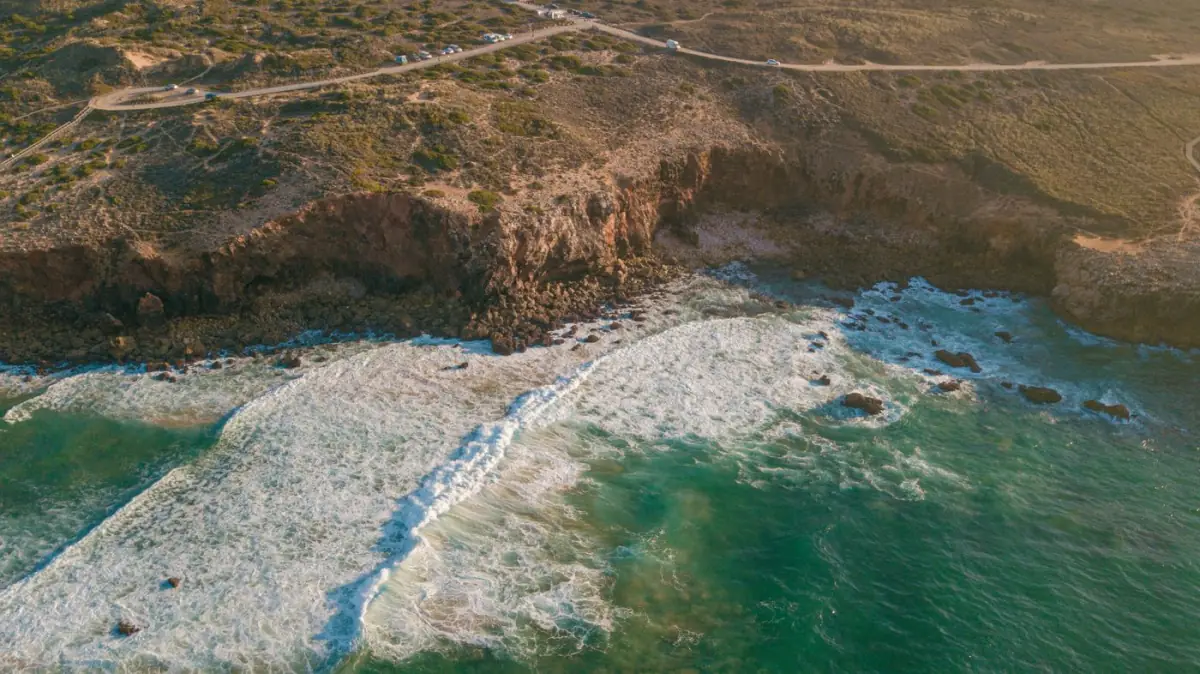
- Cold sea all year round — it's open Atlantic; a wetsuit is advisable even in summer.
- Currents and swell — entering and exiting demand reading the sea; respect the flags.
- Best for intermediate/advanced — beginners gain from lessons at the Arrifana or the Amado.
- Seasonal peaks — autumn and spring bring consistent swell and fewer people in the water.
If surf is the main reason for the trip, it's worth reading our guide to the best surf beaches in the Algarve, which crosses the Amoreira with the other peaks of the west coast and helps you choose according to level and season.
Is it safe for families with children?
For families, the Amoreira has a trump card that few Atlantic beaches offer: the river lagoon. The children play in shallow, calm and milder water, away from the breaking waves. It's that combination that makes the Amoreira a family choice despite the open sea being wild.
The rule is simple: keep the water play on the river side and reserve the sea for supervised bathing by adults and older children. The sand is wide, there's room to spare to set up base and the beach rarely reaches the capacity of the central beaches. For those who want to compare areas designed for the youngest, the guide to the best areas of the Algarve for families helps frame the Aljezur coast within the rest of the region.
There's beach support and seasonal catering, but always count on the basics brought from home, above all outside the summer months, when many services close. The Amoreira is wild by nature and part of the charm is precisely that — coming prepared is what separates a good day from an uncomfortable one.
What to do around: Odeceixe, Sagres and the Costa Vicentina
The Amoreira isn't visited in isolation — it's part of a stretch of coast full of wild beaches. A few kilometres north sits Odeceixe, another river beach on the border with the Alentejo, with sand wedged between cliffs and the same logic of a river lagoon. Odeceixe is an even smaller settlement, with about 1,055 inhabitants, and its beach rivals the Amoreira in beauty.
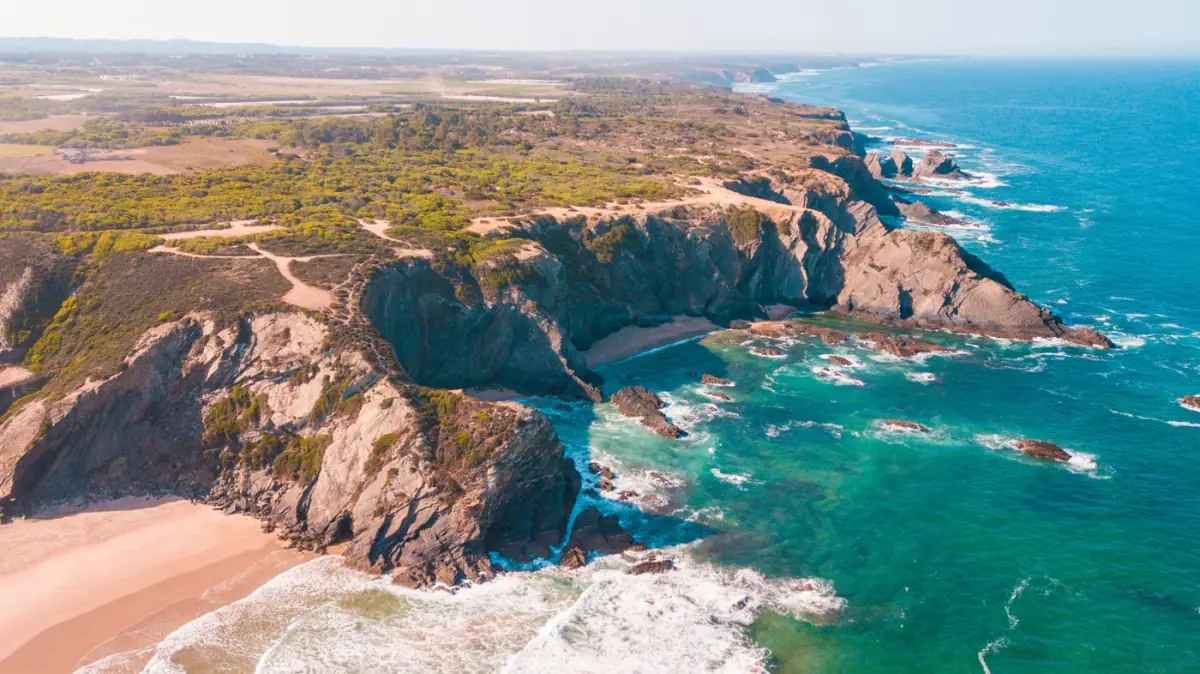
To the south, the road leads to Sagres, in the municipality of Vila do Bispo, the most south-westerly point of mainland Europe, about 87 km from Faro Airport. Cape St Vincent, the fortress and the viewpoints over the ocean round off a west-coast itinerary nicely. Between Aljezur and Sagres, the Rota Vicentina and the Fishermen's Trail offer walks along the cliff edge with constant views over the sea.
To put together a day or two around the Amoreira, our guide to Odeceixe and the one on Sagres and the Costa Vicentina fit perfectly. Those who like this more isolated register will also want the itinerary of wild and hidden beaches of the Algarve, where the Amoreira appears alongside other little-explored stretches of sand.
Where to stay near Praia da Amoreira?
Aljezur itself has limited and very seasonal accommodation, so most of those who visit the Amoreira choose a bigger base and make the beach a day trip. The most practical option in the Barlavento is Lagos, about 50 km and less than an hour's drive away, with far more choice of homes, restaurants and services. Lagos combines the convenience of a city with easy access to the west coast.
In our inventory, you'll find spacious homes in Lagos such as the 5-bedroom villa in Lagos, at 492 m², ideal for large groups or several families wanting to share a base and split the days between the beaches of Lagos and the adventures of the Costa Vicentina. Those who prefer an apartment with a pool have the 3-bedroom apartment with pool in Lagos at 150 m² and the 3-bedroom apartment with pool in Lagos at 121 m², both with room for families. Closer to the wild Atlantic of the Barlavento, there's also the 1-bedroom apartment with pool at Praia da Rocha, for couples.
Real-time availability and prices on Homing — book direct, cheaper than Booking, Airbnb and Hotels.com. Click «See dates and price».
These homes are booked direct on Homing, our official partner, which comes out cheaper than booking through Booking, Airbnb or Hotels.com — no platform commission or hidden fees, and with support in Portuguese. To understand how to choose the right base against the beaches you want to visit, the guide where to stay in the Algarve and the Barlavento vs Sotavento comparison help you decide before locking in dates.
What is the best time of year to visit?
The best time depends on what you're after. For bathing and family beach days, June to September give the warmest, most stable weather, with the beach services open. For surf and walks, spring (April–May) and autumn (September–October) bring consistent swell, fewer people and mild temperatures on land — even if the sea stays cold.
The Costa Vicentina has its own microclimate: morning fog in summer that usually lifts by mid-morning, and a north-westerly wind that cools the afternoons. The sea stays cold all year round because it's open Atlantic, without the mild water of the Sotavento. So even in August, it's normal to see bathers entering and leaving the sea quickly and spending more time in the river lagoon.
| Season | Weather on land | Sea | Atmosphere |
|---|---|---|---|
| Summer (Jun–Sep) | Warm, morning fog | Cold, variable swell | More people, services open |
| Spring (Apr–May) | Mild | Cold, good swell | Calm, ideal for surf and trails |
| Autumn (Sep–Oct) | Mild, sunny | Cold, consistent swell | Few people, quality surf |
| Winter (Nov–Mar) | Cool, rainy | Cold, wild sea | Almost deserted, dramatic scenery |
If you want to plan the trip in more detail on temperatures, prices and crowds through the year, it's worth bearing in mind that each season offers a different profile of weather, sea and footfall. The Amoreira rewards those who come outside the peak of summer: more space, better surf and the rare silence of a protected Atlantic beach.
Praia da Amoreira or other Algarve beaches: how to choose?
Choose the Amoreira if you're after nature, surf, space and the combination of river and sea; choose other areas if you want a mild sea, colourful cliffs or beaches with more support. The Costa Vicentina is the wild Algarve, and that's both its strength and its limit — those wanting resort comfort won't find it here.
For a direct contrast, the golden cliffs and the caves are concentrated in the Centro, with beaches such as Praia da Marinha and Benagil. The warm sea and the barrier islands, meanwhile, are in the Sotavento. If what attracts you to the Amoreira is the river-and-family side, but with milder water, the Sotavento is the logical alternative.
Those travelling just for the beaches should cross this guide with the list of the most beautiful beaches in the Algarve and with the itinerary of what to do in the Algarve beyond the beach. That way you can balance days on the Costa Vicentina with days of cliffs and warm sea, without being tied to a single area for the whole trip.
Sources and references
- Turismo do Algarve (Visit Algarve) — https://www.visitalgarve.pt/
- ICNF — Parque Natural do Sudoeste Alentejano e Costa Vicentina — https://www.icnf.pt/
- Wikipédia — Aljezur — https://pt.wikipedia.org/wiki/Aljezur
- Wikipédia — Costa Vicentina — https://pt.wikipedia.org/wiki/Costa_Vicentina
- Rota Vicentina — https://rotavicentina.com/
Original editorial article by Maré Algarve, based on official sources (Turismo do Algarve, ICNF, ABAE/Blue Flag, IPMA, INE) and on our experience of holiday rentals in the Algarve. Prices and availability vary — always check each property's page.