
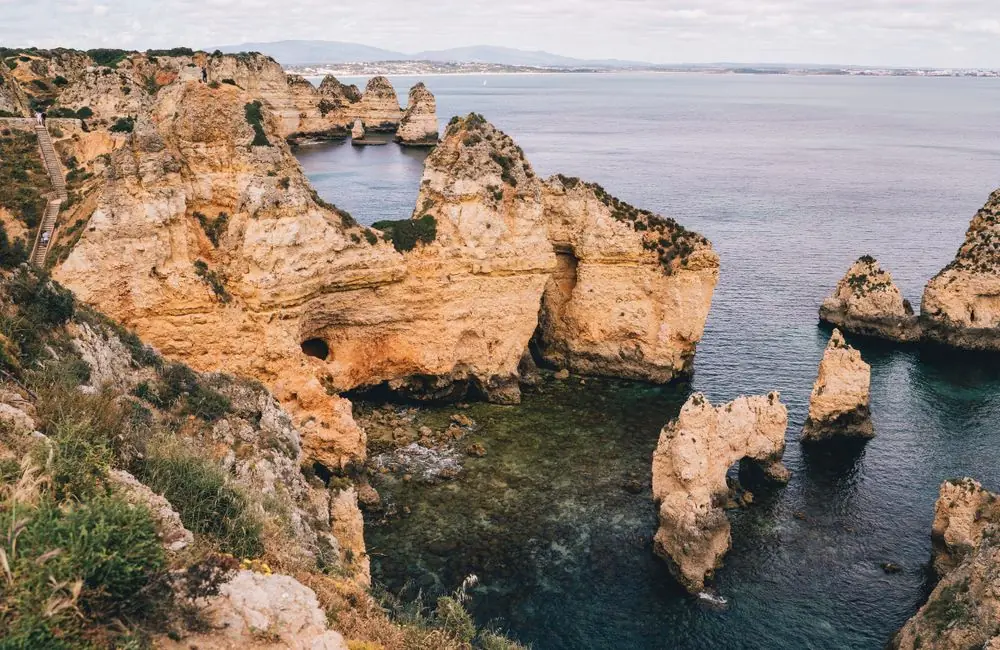
Praia do Camilo sits on the Ponta da Piedade road, about 2.5 km from the centre of Lagos, and is the most photographed of the Barlavento's small beaches — not for the sand, which is tiny, but for the wooden staircase snaking down the cliff. Below there are two coves, joined by a tunnel cut through the rock that you can only cross when the tide allows. It is a beach that demands legs, tide planning and an early start: when the car park fills, it really fills.
Where is Praia do Camilo and what sets it apart?
Praia do Camilo lies in the municipality of Lagos, in the Barlavento, on the road linking the town to Ponta da Piedade. It is tucked between Praia de Dona Ana, to the north, and the Ponta da Piedade headland, to the south — all three are done on the same outing, and that is how most visitors combine them.
What sets it apart is not the size, which is the smallest of Lagos's well-known beaches, nor the water, which is the same turquoise as the rest of this coast. It is the staircase. The zigzag wooden descent, set into the ochre cliff, has become an image in its own right: it appears on magazine covers, in tourism campaigns and in millions of photographs. Plenty of people reach the top, take the photograph of the staircase and leave without ever setting foot on the sand.
The second peculiarity is geological and is solved with a tide table: there is not one beach but two. There is a main cove at the foot of the staircase and a second, smaller cove on the other side of a short tunnel cut through the rock. At high tide the tunnel is impassable and the beach is half of what it could be. On a falling tide you walk through dry-shod and gain an almost private stretch of sand.
How many steps does the staircase have and what is the descent like?
It is the most asked question about this beach, and the honest answer is that there is no official count posted on site. The figure that circulates most often in guides and accounts is around 200 steps, and it is a plausible order of magnitude for the drop involved — but nobody publishes it as verified data, and we do not present it as such. What can be said with confidence is how the descent feels.
The staircase is wooden, with landings to rest on and handrails on both sides along virtually the whole route — which makes it, from a safety point of view, considerably more comfortable than the uneven stone staircases of other cliff beaches in the region. Going down takes three to five minutes at an easy pace. Climbing back up, in the midday sun and carrying the beach bag, is another matter: allow twice the time and one stop.
One practical consequence: the staircase is the only access. There is no ramp, no lift and no alternative route along the sand. Praia do Camilo is not wheelchair accessible and is highly impractical with a pushchair — anyone travelling with babies will find far better conditions at Meia Praia, on the other side of Lagos, which is flat and has direct access from the promenade to the sand.
How do you get to Praia do Camilo?
Praia do Camilo is about 2.5 km from the historic centre of Lagos, along the Ponta da Piedade road. There are three ways to get there and, unlike other cliff beaches in the region, none of them strictly requires a car — which makes an enormous difference in August, when the car park runs out.
- On foot from Lagos: about 35 minutes along the Ponta da Piedade road, with pavement for nearly the whole route and a moderate climb. It solves the parking problem and is what we recommend in July and August.
- By car: follow the signs for Ponta da Piedade; the Praia do Camilo car park is signposted on the left, shortly before the lighthouse.
- By bus: the Lagos urban network serves the Ponta da Piedade area in high season, with reduced frequencies outside it — check the timetable on the day before relying on it for the return.
- By taxi or ride-hailing: five to ten minutes from the centre; agree the pick-up, because there is no rank on site.
On parking: the car park on the clifftop is small and free, and it is the variable that ruins most beach days here. In July and August it fills early in the morning and cars then line the Ponta da Piedade road, sometimes for hundreds of metres. Out of season the problem disappears entirely and you park at the door at any hour.
Whichever way you arrive, the principle is the same in high season: turn up after 10am and you pay for it in walking. Outside July and August all these concerns evaporate and Praia do Camilo goes back to being what it is for nine months of the year — a quiet cove with a handsome staircase and almost nobody on it.
The double cove and the tunnel: how the tide decides your day
At this beach, the tide matters more than the time of day. At low or falling tide the main stretch of sand widens, the tunnel through the rock becomes passable and the second cove opens up — usually with half the people of the first. At high tide, especially on spring tides, the water comes close to the foot of the staircase and towel space shrinks drastically.
| Tide state | Main beach | Tunnel and second cove | Recommendation |
|---|---|---|---|
| Low water | Wide, with rocks exposed | Passable, second cove open | The best window — this is how the beach should be seen |
| Falling | Widening | Opening | Excellent: arrive two hours before low water |
| Rising | Narrowing | Closing | Acceptable, but don't linger on the far side of the tunnel |
| High water | Narrow strip against the rock | Impassable | Avoid on spring tides; the sand is almost entirely submerged |
The Hydrographic Institute publishes daily tables for the Algarve coast and checking takes less than a minute. Look for a low water between mid-morning and early afternoon and plan to arrive in the two hours before it. A safety note about the tunnel: do not stay on the far side with the tide coming in. The passage closes with the water and the second cove has no alternative way out up the cliff.
Praia do Camilo or Praia de Dona Ana: which to choose?
This is the decision almost everyone faces, because the two beaches are less than 500 metres apart and compete for the same title of Lagos postcard. The short answer: Dona Ana is the beach; Camilo is the photograph. If you're going to spend the day lying on the sand with family, choose Dona Ana. If you're going for two hours, want the image and don't mind the staircase, choose Camilo.
| Praia do Camilo | Praia de Dona Ana | Meia Praia | |
|---|---|---|---|
| Size of the sand | Very small (two coves) | Small to medium | About 4 km |
| Access | Wooden staircase, steep | Staircase, less demanding | Flat, straight off the promenade |
| Parking | Small car park, fills early | Medium car park | Ample and easy |
| Beach facilities | Restaurant on the clifftop | Beach bar | Several bars and restaurants |
| With small children | Impractical | Reasonable | The best of the three |
| Reduced mobility | Not accessible | Not accessible | Accessible |
| On foot from the centre | ≈ 35 min | ≈ 30 min | ≈ 20 min |
The best decision, in truth, is not to decide: all three can be done in one day without stress. Start at Camilo at 8.30am, with the tide falling; move on to Dona Ana mid-morning, when Camilo fills up; and finish at Meia Praia in the afternoon, which has shade, bars and room enough to stop thinking about the clock. It is the itinerary we follow and the one that gets the most out of all three.
What to see next: Ponta da Piedade, less than 1 km away
Ponta da Piedade is less than a kilometre from Praia do Camilo, on the same road, and is the natural conclusion to the visit. It is the most spectacular headland in the Barlavento: a maze of arches, caves and golden limestone pillars, with a lighthouse on top and a long staircase down to the boat landing.
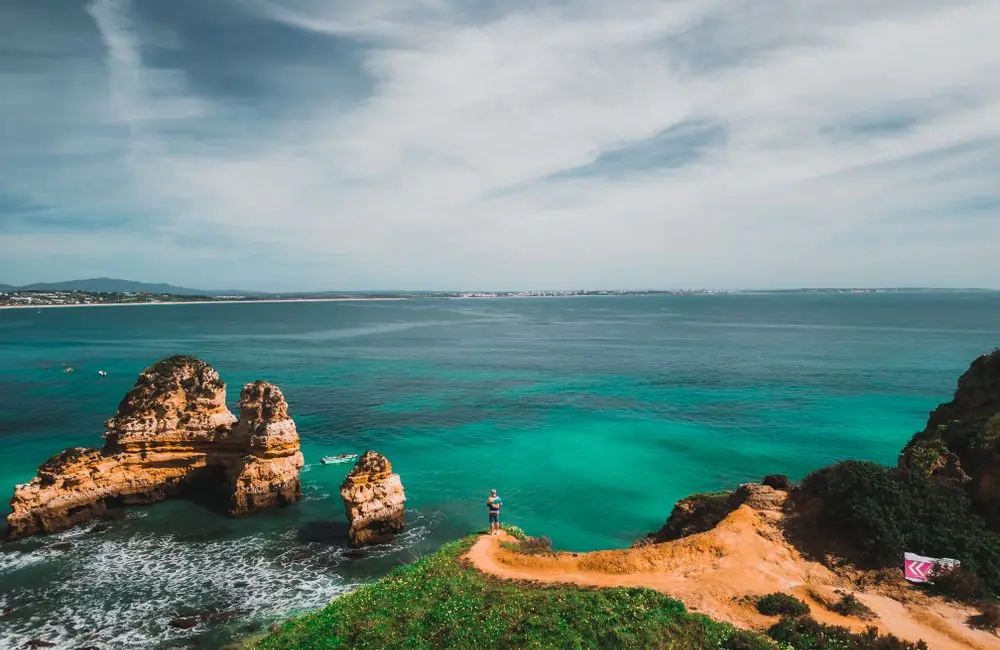
- Clifftop viewpoints: free, flat and reachable from the car park — the best effort-to-scenery ratio in the whole area.
- Staircase to the landing: long and exposed, but it leads to the departure point for the boats that tour the caves.
- Boat trips: they run continuously in summer and enter caves invisible from land; they typically last 45 minutes to an hour.
- Kayak and SUP: the closest way to see the arches, with departures from Batata and Meia Praia.
- Sunset: Ponta da Piedade faces west — this is where Lagos watches the sun drop into the sea.
If the aim is to fit both into one morning, the order that works is: Camilo early, with the tide out; back up the staircase; walk to Ponta da Piedade; and catch a boat around 11am, when the light is properly entering the caves. For more ideas in the area, the guide to where to stay in Lagos and the one on the most beautiful beaches in the Algarve help fill out the rest of your days.
What time to go and what to bring?
Praia do Camilo is small enough that your arrival time changes everything. In July and August, arrive at 8.30am and you find the sand almost empty, spaces in the car park and the staircase clear to photograph; arrive at midday and you find a queue on the staircase, a full beach and your car 400 metres away. Out of season — October to May — the question simply doesn't arise.
- Footwear with a heel strap: the staircase is wooden and has landings, but the climb in flip-flops carrying bags is uncomfortable.
- Travel light: everything that goes down comes back up — leave the big cool box and the heavy chair in the car.
- Water and sunscreen: the sand sits between cliffs and catches direct sun for much of the day.
- Snorkelling mask: the water is clear and the side rocks hold fish — it is the Lagos beach where snorkelling pays off most.
- Tide table on your phone: it is what decides whether you see one beach or two.
There is a restaurant on the clifftop, beside the car park, with a terrace facing the sea — handy for lunch, but expect a wait in August. On the sand below there is no bar and no parasol hire, so bring from home whatever you need for the hours you'll spend there. If you want to combine beaches with the rest of the region, our guide to the best beaches in the Algarve organises the options by profile.
Where to stay near Praia do Camilo?
The answer is simple: Lagos. Staying in town solves the parking problem — because you can walk — and gives you access to everything else without a car: the historic centre, the marina, the restaurants, Meia Praia and the Ponta da Piedade boats. It is one of the few areas in the Algarve where a beach holiday works well without depending on a vehicle.
Our inventory has 15 homes in Lagos, with a median of 115 m² — among the largest anywhere in the Algarve, well above the 75 m² median for apartments across the inventory. It is an area of spacious accommodation, typically two and three bedrooms, with a shared pool in the complex. We have no homes with a private pool in Lagos; for that, the areas with the most supply are Almancil and Alvor.
Real-time availability and prices on Homing — book direct, cheaper than Booking, Airbnb and Hotels.com. Click «See dates and price».
These homes are booked directly through Homing, our official partner, with no platform commission — which makes them cheaper than on Booking, Airbnb or Hoteis.com. To see more options, browse the apartments available, the region's villas, or run your own search across all the homes in the Algarve.
Is Praia do Camilo worth it?
It is — with one condition. If you go expecting a full day at the beach, with space, shade and service, you'll come away disappointed: the sand is small, there are no facilities on it and in August it fills before midday. If you go expecting two hours in one of the most beautiful landscapes in Europe, with clear water, a staircase that is itself a monument and a tunnel opening onto a second beach, it is hard to fall short of expectations.
The classic mistake is going in the middle of the day, in August, at high tide, with a cool box. You get the worst of everything: a crowded staircase, no sand, no tunnel and the climb back in the two o'clock sun. Done the other way round — 8.30am, falling tide, a light rucksack — it is one of the best mornings the Algarve has to offer, and you leave understanding why this staircase turns up on so many covers.
To carry on exploring this coast, see the Algarve beaches with accommodation attached, the guide to wild and hidden beaches if you want to escape the crowds, or Sagres and the Costa Vicentina for the wilder side of the Barlavento.
Sources and references
- Turismo do Algarve (Visit Algarve) — https://www.visitalgarve.pt/
- Lagos Town Council — https://www.cm-lagos.pt/
- ABAE — Blue Flag — https://bandeiraazul.abae.pt/
- Hydrographic Institute — tide tables — https://www.hidrografico.pt/
- IPMA — Portuguese Institute for Sea and Atmosphere — https://www.ipma.pt/
Original editorial article by Maré Algarve, based on official sources (Turismo do Algarve, ICNF, ABAE/Blue Flag, IPMA, INE) and on our experience of holiday rentals in the Algarve. Prices and availability vary — always check each property's page.