
Faro is the capital of the Algarve, has 64,560 inhabitants and sits 3 km from the airport — closer than any other base in the region. It has a walled old town, the Ria Formosa lagoon starting at the end of the street, and a city life that carries on in January, when half the Algarve shuts.
What Faro is not: a beach town. The city beach sits on a barrier island across the lagoon, and you cannot walk to it. This guide explains when that is a problem and when it is exactly what you want — with the real figures from the 13 homes we have in the city.
Why stay in Faro rather than a beach town?
The honest answer is: it depends on the kind of holiday. If the plan is to walk out of the door and be on the sand in five minutes, Faro is the wrong choice — ten Algarve towns do that better. If the plan is to use the Algarve as a region rather than a resort, Faro is the most efficient base there is.
Three things set Faro apart. It is the only city — with a hospital, a railway station, a university and shops that do not close in November. It is the closest point to the airport, at 3 km. And it is the gateway to the Ria Formosa, the 60 km lagoon that defines the whole Sotavento and which you can reach from here by boat in twenty minutes.
There is also the off-season argument. In January and February many Algarve towns are left with half their restaurants closed and empty streets. Faro is not — it has 64,560 people living there all year, and that shows in everything, from the café open at eight in the morning to the supermarket on a Sunday.
3 km from the airport: what that changes in practice
Three kilometres is about ten minutes by taxi, and a city bus runs the route. Compared with the rest of the region: Quarteira is 13 km out, Vilamoura 15, Albufeira around 35 and Sagres nearly 90. The difference looks small on a map and is enormous in practice.
What this solves, in order of importance. Late arrivals: a flight landing at 11.30pm means being home before midnight, rather than an hour on unfamiliar roads. Early departures: a 7am flight does not mean getting up at 4. Short stays: on a two-night weekend, two hours of travel is a quarter of the useful time.
It also settles the car question. Faro is the only Algarve base where you can spend a whole week without hiring a vehicle: there are trains to Tavira, Olhão and Lagos, buses to the Sotavento towns and boats to the islands. The guide on getting to and around the Algarve covers the connections in detail.
Where to stay within Faro: the areas
The city is small and walkable end to end in twenty minutes, but the areas are not equivalent. These are the four that matter to anyone renting a home.
| Area | What it is like | Best for |
|---|---|---|
| Vila Adentro (old town) | Inside the walls, cobbles, cathedral and museum | Wanting to step out into the centre |
| Baixa and Rua de Santo António | Shops, terraces, pedestrian streets | A first visit, without a car |
| Dock and lagoon front | Marina, Manuel Bívar gardens, boats to the islands | Anyone who will use the boats |
| Outside the centre | Residential streets, more space and parking | Families and longer stays with a car |
The simple recommendation: without a car, stay inside the quadrilateral between the Baixa and the Dock — it puts everything within walking distance, including the boat quay. With a car, it is worth moving slightly out of the centre, because parking inside the walls is difficult and expensive and the difference is five minutes on foot.
A note on noise that no guide writes down: Rua do Prior and the streets around Largo do Carmo hold the bars, and on Friday and Saturday they can be heard until late. If sleep is the priority, ask for a home facing the inside of the block or stay two streets up — the difference is large and the price is the same.
What does renting a home in Faro cost?
We have 13 homes in Faro, nearly all apartments — which is the city's building type, unlike the beach towns where houses dominate. The figures below come from our real inventory, not estimates.
| Indicator | Faro | Algarve median |
|---|---|---|
| From | €49 / night | — |
| Median price | €65 / night | €52 (Vilamoura) · €41 (Albufeira) |
| Median floor area | 106 m² | 86 m² (Vilamoura) |
| Space per guest | 19.8 m² | 16.8 m² |
| Bathrooms (median) | 2 | 1 |
Two readings worth having. Faro is more expensive per night than Albufeira or Quarteira — but it is also where you sleep with the most space per person in the whole inventory: 19.8 m² per guest against an average of 16.8. And a median of two bathrooms, against one across the rest of the region, changes a family week considerably. To frame the total cost, see what it costs to rent a holiday home in the Algarve.
On amenities: 100% of our Faro homes have wifi, 85% air conditioning and 69% a garden or patio. Lifts and washing machines appear in 38% — low figures explained by the old building stock in the centre, and worth checking on the listing if they matter to you.
On season: the figures above are year-round medians. They rise in August and fall in January and February — and Faro is one of the few bases where that fall does not come with half the town closed, because the city lives off its residents and not only off tourism.
Does Faro have a beach?
It does, but not at the door. The city beach sits on a barrier island across the lagoon, reached by car on the road that runs past the airport, or by boat from the dock. It is not a beach you walk to from the centre.
This is the point that decides it for many people, and it is worth being clear: anyone who wants to wake up, put on a swimsuit and walk down to the sand should choose another base. Anyone who accepts fifteen to twenty minutes to the beach, in exchange for a real city around them, is well served — and gains access to the Ria Formosa islands, which are stretches of sand no Algarve beach town has.
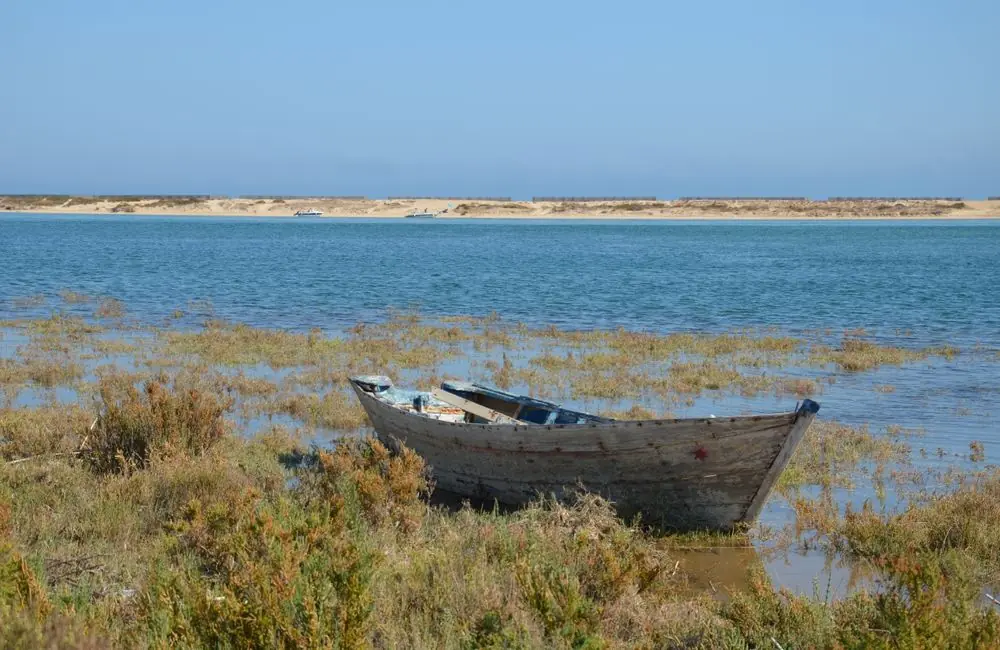
The islands are reached by boat from the Faro dock, on short crossings. It is the same lagoon system that serves Olhão and Tavira, and which the Ria Formosa guide explains in full. Praia da Ilha de Tavira and Praia do Barril are the best known of the set.
What to do in Faro in two days
Faro works well in two days, and the old town is small enough not to need planning. A route that works:
- Vila Adentro — in through the Arco da Vila, up to the cathedral and the Municipal Museum, housed in a former convent
- Dock and Manuel Bívar gardens — the waterfront, with the boats and the cafés
- Ria Formosa islands — half a day by boat, which is the reason to stay in Faro at all
- Municipal market — morning fish and the best reading of what the region eats
- Olhão or Tavira — twenty minutes by train, and a completely different atmosphere
On food: Faro eats fish and shellfish from the lagoon, and it is the right city to try clams and oysters at source. The guides to where to eat fresh seafood and to typical Algarve dishes help with what to order.
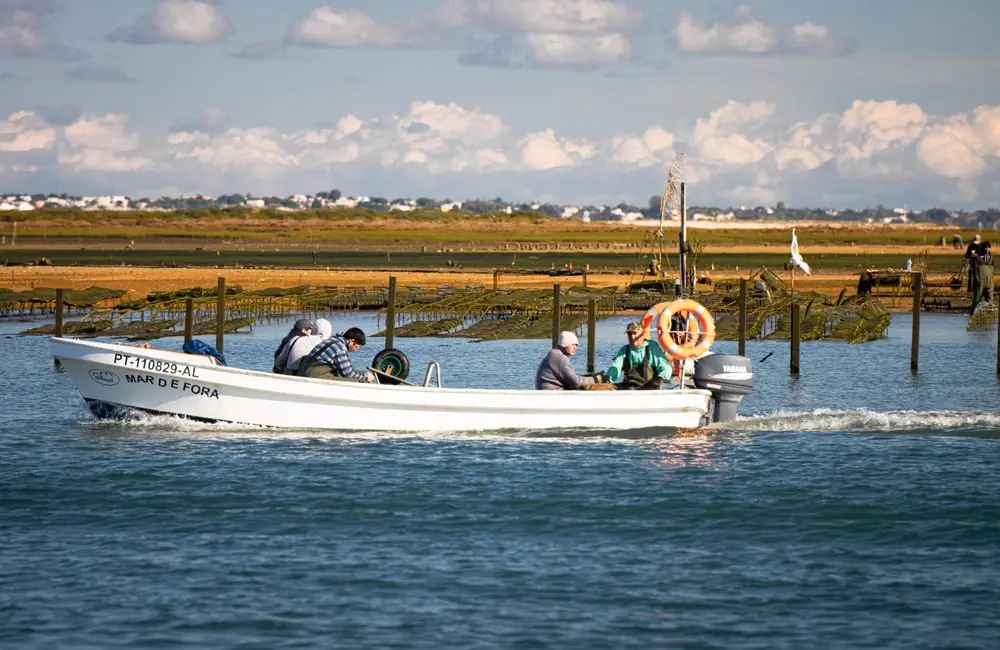
Two things that usually get left out and are worth the detour. The Chapel of Bones, at the Carmo church, is small and striking — twenty minutes. And the wall viewpoint, on the lagoon side of Vila Adentro, is the best spot in the city late in the afternoon, when low tide exposes the channels.
Faro as a base: what is nearby
Faro's advantage is geographic: it sits in the middle of the Sotavento and at the edge of the Centre, which puts a lot within half an hour. The table gives distances to Faro airport by town, from our inventory.
| Destination | km to airport | What it has |
|---|---|---|
| Faro | 3 km | City, Ria Formosa, trains |
| Olhão | 11 km | Markets, boats to the islands |
| Quarteira | 13 km | Fish auction, urban beach |
| Vilamoura | 15 km | Marina, golf, restaurants |
| Almancil | 10 km | Quinta do Lago, fine dining |
With a car the Barlavento is an hour away and the Costa Vicentina an hour and a half — perfectly doable as day trips. Without a car, the Algarve railway line handles the Lagos–Faro–Vila Real de Santo António axis, and the Sotavento guide shows what lies east.
A warning about tolls: the A22, the Algarve motorway, is electronic and has no booths. Anyone hiring a car should check that the vehicle carries a transponder, because paying afterwards means a trip to the post office with the registration and the dates. The EN125 has no tolls, but takes longer.
Homes to rent in Faro
These are homes from our inventory in the city, with live availability and prices. The dominant type is the apartment, and the median floor area — 106 m² — is the largest of any town where we have homes.
Real-time availability and prices on Homing — book direct, cheaper than Booking, Airbnb and Hotels.com. Click «See dates and price».
If you would rather stay outside the city but close by, Olhão is 11 km away and cheaper, Santa Luzia at 29 km is the octopus capital, and Cabanas de Tavira has the lagoon at the door with an island opposite.
Is Faro worth it as a holiday base?
It is, for one specific kind of trip. Faro is the right base for short stays, for awkward arrivals and departures, for off-season holidays and for anyone who would rather not hire a car. In those four scenarios there is no better option in the Algarve.
It is not the right base for a beach week with small children. The daily logistics of getting to the sand weigh on you, and for a median of €41 in Albufeira that is solved on foot. It is a choice, not a flaw — and better known before booking than after.
The argument that usually decides it: Faro is the only city in the Algarve where you can have a holiday and a normal life at the same time — market in the morning, island in the afternoon, dinner on a street where people actually live. Anyone who has done the resort Algarve and wants something else tends to end up here. To compare with the rest of the region, see the best restaurants in the Algarve by area and the Tavira guide, which is the closest alternative in spirit.
Sources and references
- Faro Municipal Council — https://www.cm-faro.pt/
- Ria Formosa Natural Park — ICNF — https://www.icnf.pt/
- Comboios de Portugal — Algarve line — https://www.cp.pt/
Original editorial article by Maré Algarve, based on official sources (Turismo do Algarve, ICNF, ABAE/Blue Flag, IPMA, INE) and on our experience of holiday rentals in the Algarve. Prices and availability vary — always check each property's page.