
Monte Gordo is the easternmost seaside village in the Algarve, a few kilometres from the Spanish border, in the municipality of Vila Real de Santo António. The beach is known for one concrete thing: the sea is the warmest in mainland Algarve, with the water reaching 22–24 °C at the height of summer, because the south-east-facing coast catches the milder influence of the Gulf of Cádiz.
A wide beach, dunes with boardwalks, a pine wood separating the beach from the village and a small, flat centre that's easy to walk. It's a destination that works above all for families and for those after peace and quiet without giving up having everything open on the doorstep.
Where is Monte Gordo and why is it different?
Monte Gordo sits at the far eastern end of the Algarve, in the Sotavento, within the municipality of Vila Real de Santo António. It's around 49 km from Faro Airport, which means 40 to 50 minutes by car on the A22 motorway, and less than 5 km from the Spanish border, beside the mouth of the river Guadiana.
What sets it apart from the rest of the Algarve is the sea. While the Barlavento, around Lagos and Sagres, catches the cooler currents of the open Atlantic, the Sotavento faces south and east and takes in calmer, milder waters. In Monte Gordo this translates into the warmest bathing water on the Algarve mainland coast — a difference you feel on your skin as early as June.
The village grew up around the beach and an old tuna-fishing settlement. Today it's a flat, compact cluster, with short avenues running perpendicular to the sea, separated from the beach by a wood of stone pines that gives shade and cools the air on the hottest days. It's the kind of place where you arrive, park the car and spend the week on foot.
What is Monte Gordo beach like?
Monte Gordo beach is a wide, flat stretch of fine golden sand, with a very gentle slope into the water. The sea stays shallow for dozens of metres, which makes bathing safe and makes it one of the most sought-after beaches in the Sotavento for families with small children. It carries the Blue Flag and has beach facilities, lifeguards in season and access via wooden boardwalks over the dunes.
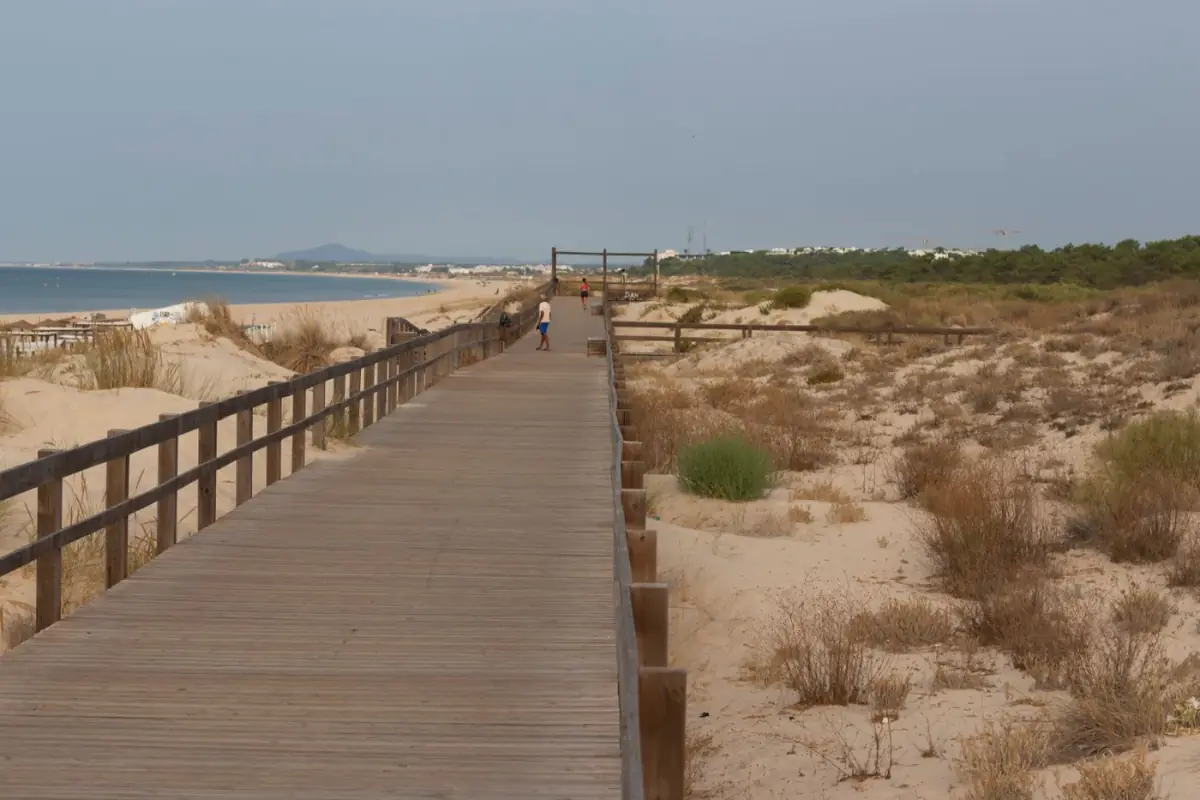
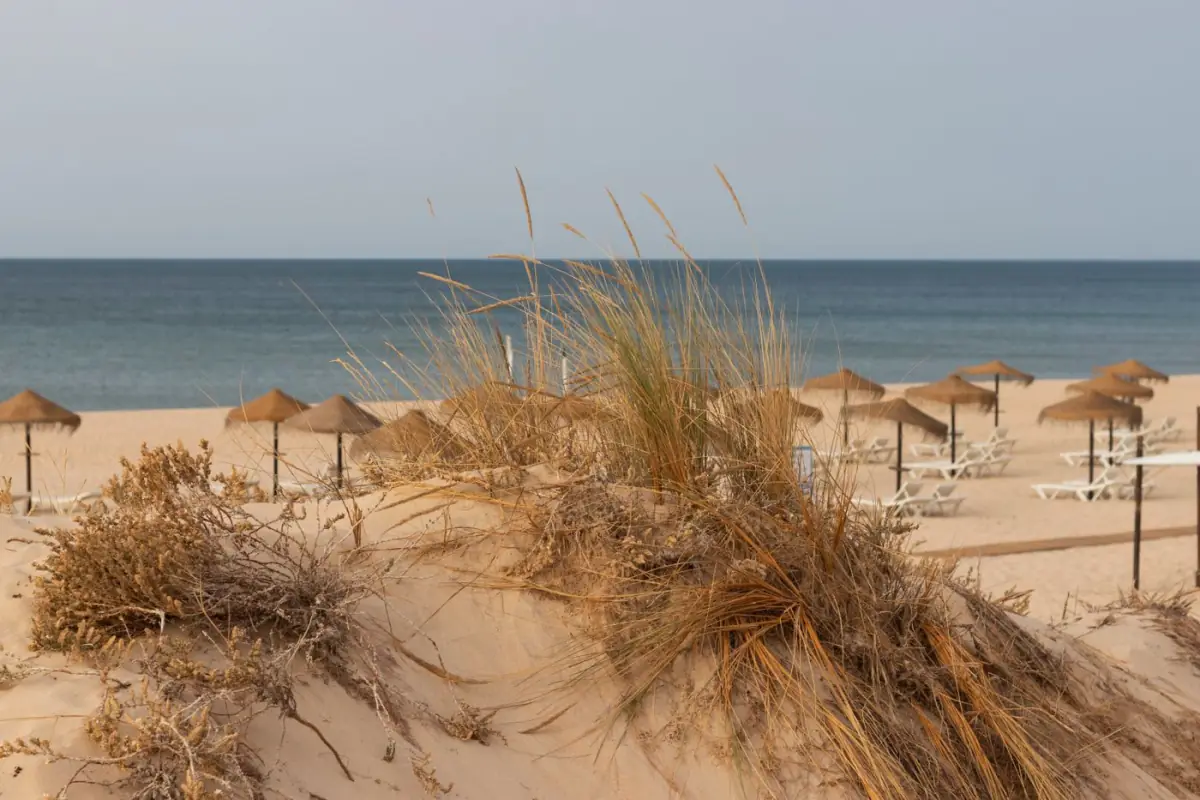
The sand is so wide that even in August there's room to spread your towel well away from your neighbour. There are concessions with parasols and sun loungers for hire, beach restaurants for a lunch of grilled fish and a flat seafront ideal for late-afternoon strolls. To the east, the beach runs almost without a break as far as Praia da Ponta da Areia and the mouth of the Guadiana; to the west, it stretches towards Altura and Praia Verde.
Is the sea really the warmest in the Algarve?
Yes. The water temperature in Monte Gordo hovers around 22–24 °C in July and August, against the 18–20 °C typical of the Barlavento beaches over the same period. The explanation lies in the orientation of the coast: facing south-east and sheltered from the open Atlantic, it takes in the milder water that rises from the Gulf of Cádiz. For those who don't like cold water, this is the Algarve beach where bathing is most comfortable.
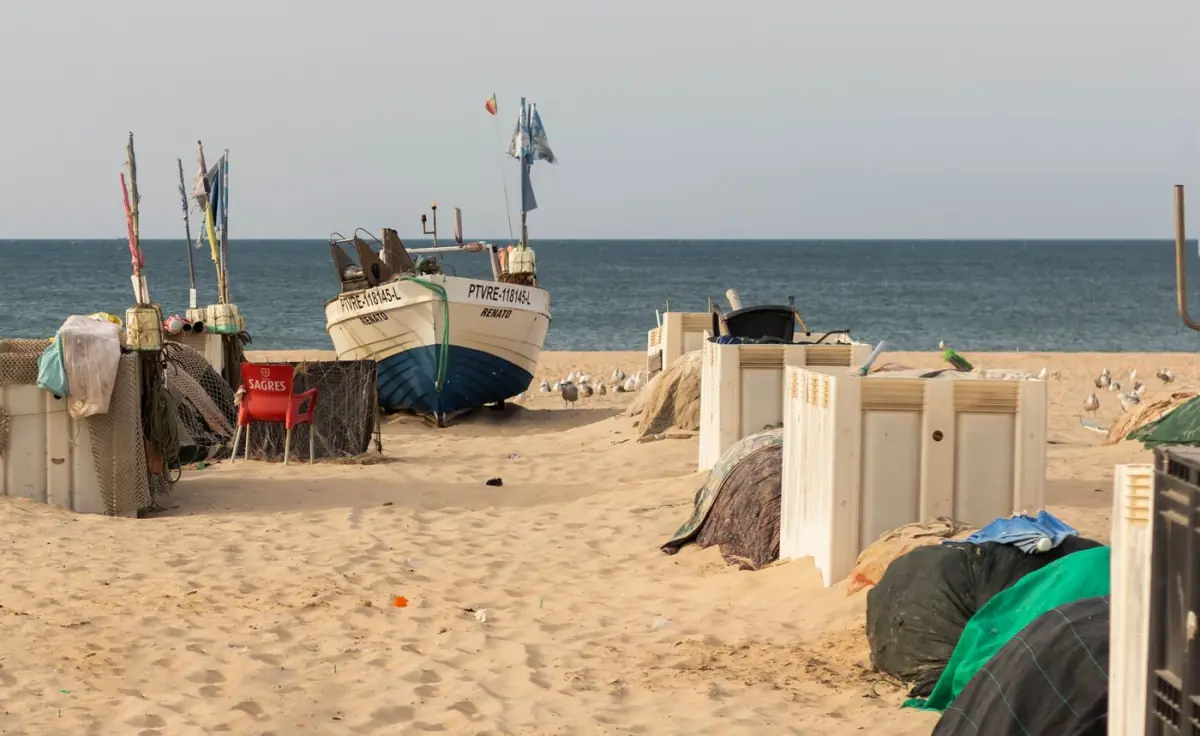
Its family appeal becomes clear when you compare it with other areas. For a broader look at the calm beaches with wide sand and mild seas, the Algarve with children guide places Monte Gordo among the best choices in the Sotavento, alongside Tavira and Cabanas.
What is there to do in Monte Gordo?
In Monte Gordo the beach rules, but the village has more than just sand. The flat centre concentrates fish and seafood restaurants, terraces, a small municipal market and the casino, one of the oldest in the Algarve, facing the beach. The seafront avenue and the pine-wood promenade are the stage for late-afternoon strolls, on foot or by bike.
- Monte Gordo pine wood — an area of stone pines between the village and the beach, with shade, walking trails and fresh air on hot days.
- Monte Gordo casino — a gaming room and shows a few metres from the sand, for the evenings.
- Market and fish restaurants — sardines, tuna, fried cuttlefish and seafood from the Ria Formosa and the Guadiana.
- Bike rides — the flat terrain links Monte Gordo to Vila Real de Santo António and the national forest along the cycle path.
- Castro Marim marshland — a nature reserve with flamingos and salt pans a few minutes away, ideal for birdwatching.
Anyone wanting to go beyond the beach has the whole Sotavento on the doorstep. The Ria Formosa and the barrier islands begin to the west, and the coast fills with salt pans and marshes to the east. The Sotavento guide links these stops into a single itinerary, from nature to culture.
What to visit near Monte Gordo?
Monte Gordo is surrounded by some of the most authentic spots in the Sotavento, all less than half an hour away. The village works well as a base for exploring the eastern tip of the Algarve without long journeys.
Vila Real de Santo António
A few minutes away lies Vila Real de Santo António, a town of nearly 19,000 inhabitants laid out on a grid by the Marquis of Pombal in the 18th century. It has a riverside front over the Guadiana, the central square with its radiating cobbles and shops for cross-border shopping. From here the ferry leaves for Ayamonte, in Spain — the guide to the border town details what to see and how to cross.
Cacela Velha
To the west, about 15 minutes away, is Cacela Velha, a tiny hamlet on a low cliff, with a white church, a fort and a view over the Ria Formosa lagoon that is among the most beautiful in the Algarve. Cacela beach can be reached on foot at low tide or by boat.
Further west come Tavira, 30 minutes away, and Olhão, with its markets and the islands of the Ria Formosa. For a complete view of this stretch of coast, the Sotavento guide links Tavira, Olhão and the Ria into a single itinerary.
When to go to Monte Gordo?
The best time depends on what you're after, but Monte Gordo has one advantage: the sea stays mild earlier and later than in the rest of the Algarve. In June the water is already comfortable and in September it's still warm, which stretches the bathing season at both ends.
| Season | Months | Weather and sea | Atmosphere and price |
|---|---|---|---|
| Low | November to March | Mild (16–19 °C air), sea at 16–18 °C | Quiet village, good-value homes, plenty of space |
| Mid | April, May and October | Good (20–23 °C), sea at 17–20 °C | Moderate demand, good price/climate balance |
| High | June to September | Warm (26–28 °C), sea at 22–24 °C | Beach full, prices at their peak, book early |
For those wanting warm sea without the crowds, June and the first half of September are the sweet spot. Anyone travelling with family at the height of the holidays should book well in advance, especially for apartments near the beach. The month-by-month price calendar helps you choose the ideal week and lead time.
Where to stay in Monte Gordo: homes and areas
The dominant accommodation in Monte Gordo is the apartment and studio near the beach, rather than the standalone villa. The village is compact, so almost everything is a few minutes' walk from the sand, and prices tend to be lower than in the Golden Triangle or the touristy Barlavento. The bands below are indicative per night, self-catering — they vary with the dates and lead time; always confirm on each home's page.
| Type of home | Low season | High season |
|---|---|---|
| Studio | €40–75 | €95–170 |
| 1- to 2-bedroom apartment | €50–95 | €130–240 |
| 2- to 3-bedroom apartment with pool | €70–130 | €160–320 |
In our inventory in Monte Gordo there are mostly apartments and studios a short walk from the beach. For larger groups or families wanting a kitchen and more bedrooms, it's worth comparing with the villas of Cabanas de Tavira and Santa Luzia, further west.
Among the real homes available, there's a 1-bedroom apartment in Monte Gordo of 60 m² and another 1-bedroom of 50 m², both a few minutes from the sand and tailored to couples or small families. For those travelling as a couple and wanting to save, the studio in Monte Gordo of 32 m² is the most budget-friendly option, while still being right by the beach. Anyone needing a more central base in the Sotavento will also find a larger apartment in Faro, halfway to the Ria Formosa.
Real-time availability and prices on Homing — book direct, cheaper than Booking, Airbnb and Hotels.com. Click «See dates and price».
Booking these homes direct on Homing, our official partner, comes out cheaper than Booking, Airbnb or Hotels.com: there's no platform commission or hidden fees, and support is in Portuguese, English, French and Spanish. It's the way to pay for the home and not for the middleman.
How to get to Monte Gordo?
The most common way in is by car from Faro Airport, around 49 km on the A22 (Via do Infante), a journey of 40 to 50 minutes. The A22 runs parallel to the coast and leaves Monte Gordo a few minutes from the last exit, beside Vila Real de Santo António.
- By car — from Faro Airport, A22 eastbound to the Monte Gordo/VRSA exit; around 49 km and 45 minutes.
- By train — the Algarve line ends at Vila Real de Santo António, a few minutes from Monte Gordo, with connections to Faro, Tavira and Olhão.
- By bus — there are regional and express services linking Faro and the main Sotavento villages to VRSA and Monte Gordo.
- From Spain — those arriving via Ayamonte can cross the Guadiana bridge or take the ferry to VRSA.
Within the village you barely need the car: the centre is flat and the beach is a short walk from any point. A vehicle is mainly useful for visiting Cacela Velha, Tavira or the Castro Marim marshland. To plan longer journeys around the Algarve, the where to stay guide gives the context of the distances between areas.
Monte Gordo or another Sotavento village?
Monte Gordo is the right choice for those who want warm sea, a wide beach and a flat, quiet village, with everything on foot and prices below the Algarve average. It's not the place for intense nightlife nor for those after the glamour of the Golden Triangle — it's a relaxed, family beach destination.
If you prefer a historic village with more urban soul, Tavira (30 minutes away) combines heritage, river and the Ilha de Tavira. For your feet in the sand in a fishing-village setting, Santa Luzia and Cabanas offer barrier islands and seafood. And anyone wanting to compare coasts in one go should read the Barlavento vs Sotavento guide before deciding.
Whichever village you choose, the rule that saves the most is the same: book your home direct on Homing, compare the price bands in the Algarve cost table and book the summer weeks early, when demand in the Sotavento tightens.
Sources and references
- Turismo do Algarve (Visit Algarve) — https://www.visitalgarve.pt/
- Wikipedia — Algarve — https://pt.wikipedia.org/wiki/Algarve
- Wikipedia — Monte Gordo — https://pt.wikipedia.org/wiki/Monte_Gordo_(Vila_Real_de_Santo_Ant%C3%B3nio)
- ABAE — Blue Flag — https://bandeiraazul.abae.pt/
- ICNF — Castro Marim Marshland Nature Reserve — https://www.icnf.pt/
- Vila Real de Santo António Town Council — https://www.cm-vrsa.pt/
Original editorial article by Maré Algarve, based on official sources (Turismo do Algarve, ICNF, ABAE/Blue Flag, IPMA, INE) and on our experience of holiday rentals in the Algarve. Prices and availability vary — always check each property's page.