
Vila Real de Santo António is the easternmost town in the Algarve, built from scratch in 1774 on a grid plan in the Pombaline style, right on the bank of the river Guadiana that separates Portugal from Spain. It sits around 53 km from Faro Airport, has about 19,000 inhabitants in the municipality and works as a gateway for those arriving from Andalusia — but what holds visitors is the rare combination of an orthogonal historic centre, wide fine-sand beaches at Monte Gordo and the protected Castro Marim saltmarsh next door.
Where is Vila Real de Santo António and why is it different?
Vila Real de Santo António sits at the far eastern end of the Algarve Sotavento, in the municipality of the same name, hard against the mouth of the river Guadiana that forms the border with Spain. It's around 53 km from Faro Airport (some 45 minutes via the A22) and a few metres from Ayamonte, on the other side of the river. This hinge position between two countries defines everything: the town's culture, food and rhythm are Iberian, one foot in Portugal and an eye on Spain.
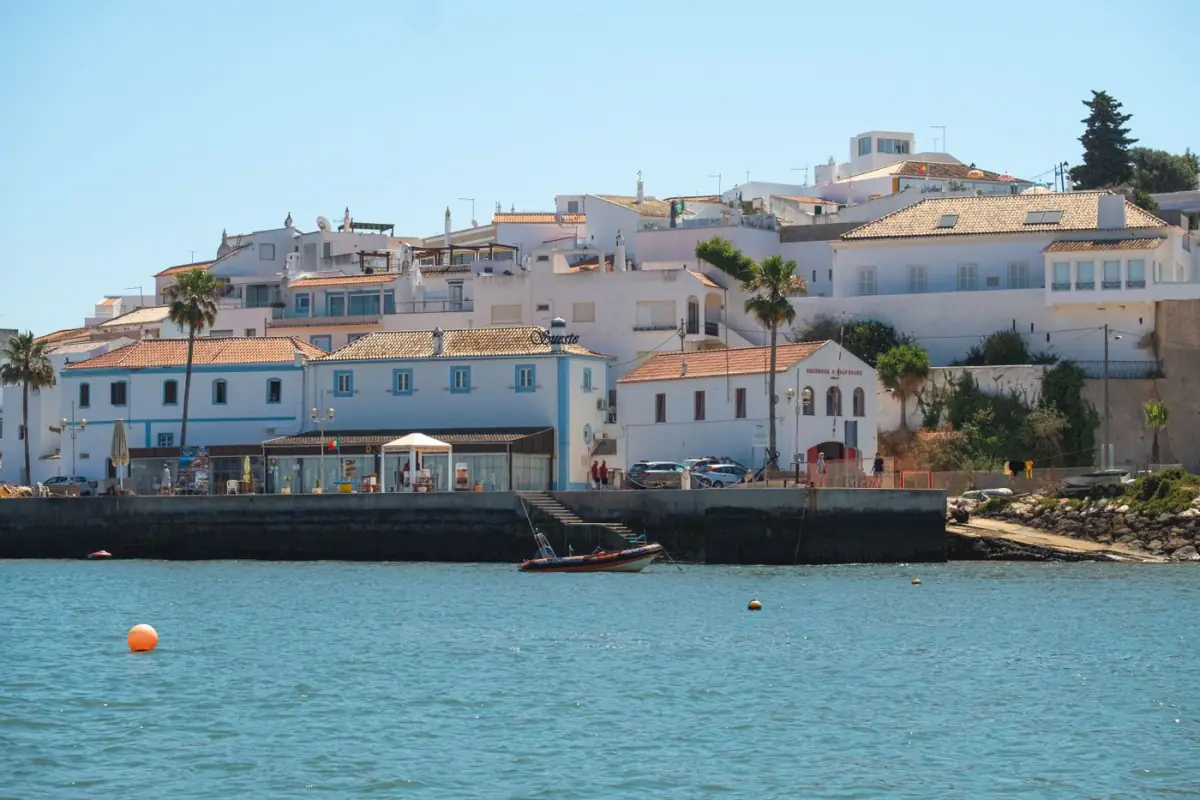
What makes the town unique in the Algarve is its origin. It didn't grow organically like Tavira or Olhão: it was designed from scratch in 1774, in just five months, by order of the Marquis of Pombal, with an orthogonal grid layout echoing the Pombaline Baixa of Lisbon. Walking from the river up to the Praça Marquês de Pombal means crossing an intact 18th-century urban plan, with perpendicular streets, uniform low buildings and a central square paved in black-and-white cobbles.
This dual identity makes Vila Real de Santo António a different base from the better-known tourist towns. Those after the beach have Monte Gordo three kilometres away; those after history have the Pombaline town on the doorstep; and those who want to switch between Portugal and Spain are at the only point in the Algarve where you do it on a boat trip. To see how it fits with the rest of the region, it's worth reading the guide to the Sotavento and the Barlavento versus Sotavento head-to-head.
What is the Pombaline town like and what to see in the centre?
The historic centre of Vila Real de Santo António is organised around the Praça Marquês de Pombal, a perfect square paved with a radial pattern of basalt and limestone around a central obelisk. It's the heart of the town and the finest example of Enlightenment Pombaline urbanism applied to a whole settlement, not just a neighbourhood. The streets that lead off the square are all straight and numbered by logic, which makes the town easy to explore on foot and impossible to mistake for any other in the Algarve.
What not to miss in the centre
- Praça Marquês de Pombal — the geometric core of the town, ringed by terraces, with the parish church on one side.
- Avenida da República and the riverside promenade — a stroll along the Guadiana with views over Ayamonte and the boat traffic.
- Centro Cultural António Aleixo — a former market reconverted, with cultural programming throughout the year.
- Quay and ferry terminal — where the crossing to Spain departs, beside the old buildings of the canning industry.
The human scale is the great asset: everything is done on foot, without big-city traffic, and the centre keeps traditional shops mixed with stores aimed at the Spanish visitors who cross the river to go shopping. At the end of the day, the terraces along the riverfront fill up to watch the sun drop over the Guadiana, with Andalusia silhouetted on the far bank.
What are the beaches of Vila Real de Santo António?
The municipality's great beach is Praia de Monte Gordo, three kilometres from the centre: a wide, flat, south-facing beach, with waters that tend to be the warmest in the Algarve because they lie at the easternmost, most sheltered tip of the coast. The sea warms up earlier in the season and stays pleasant into early autumn, which makes this area a strong choice for families with small children.
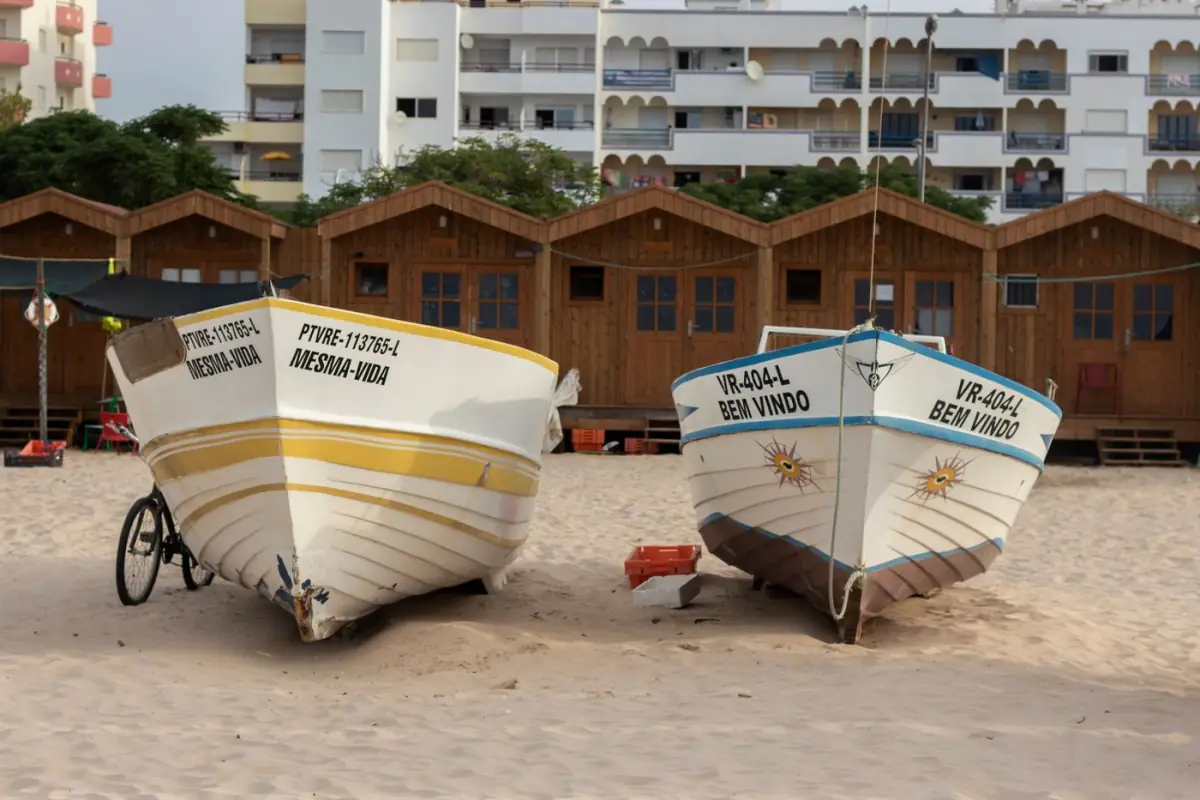
East of Monte Gordo, the beach runs unbroken to the mouth of the Guadiana itself, beside Praia de Vila Real de Santo António and the Lota area, with dunes and pine woods separating the sand from the road. It's a very long ribbon of sand, with plenty of space even in August, and several entrances with bars and concessions. For those who want to compare it with other beaches in the region before deciding, our guide to the best beaches in the Algarve and the list of Blue Flag beaches help to set the scene.
A few kilometres to the west, already in the municipality of Tavira, lies the lagoon system of the Ria Formosa and neighbouring Cacela Velha, with its island beach of calm waters. This proximity between a warm-water ocean beach and a protected saltmarsh is what sets the eastern Algarve's seaside on offer apart: one morning you sunbathe on a wide beach, in the afternoon you watch birds in the saltmarsh.
Are the Castro Marim saltmarsh and the river Guadiana worth it?
Yes, above all for those who like nature and quiet. The Castro Marim and Vila Real de Santo António Saltmarsh Nature Reserve was the first protected area created in Portugal, in 1975, and occupies the wetlands between the two towns. It's a territory of salt pans, channels and mud where dozens of species of waterbird nest and overwinter, including flamingos, which are often seen feeding in the salt flats.
What to do between the saltmarsh and the Guadiana
- Birdwatching on the reserve trails, best at dawn and at low tide.
- Traditional salt and fleur de sel from the Castro Marim salt pans, on sale in the area.
- Castro Marim Castle, with views over the saltmarsh and the Guadiana as far as Spain.
- Boat trips on the Guadiana, heading up the river towards Alcoutim and the inland border.
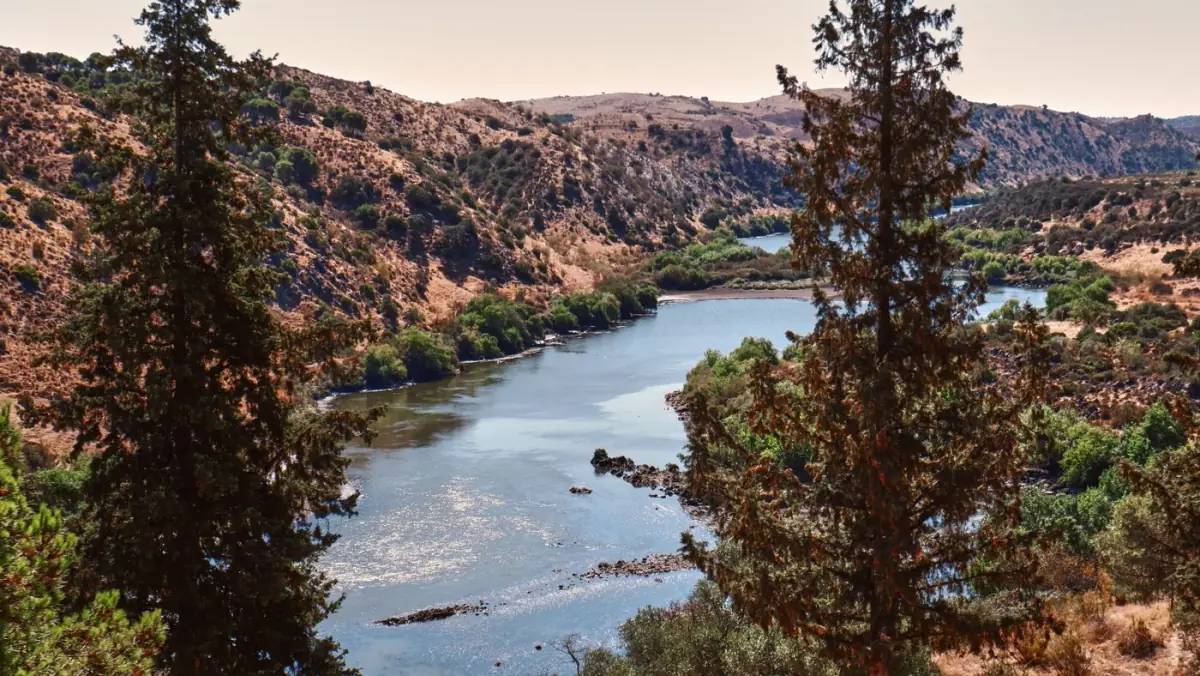
The Guadiana is the thread running through this whole area. You can cross it on foot or by car over the Guadiana International Bridge, or more memorably on the ferry that links Vila Real de Santo António to Ayamonte in a few minutes. Heading up the river by boat, in turn, leads to riverside villages like Alcoutim, in a landscape of green hills very different from the coast. It's a side of the Algarve that escapes those who only know the beaches of the Centre.
Where to stay in Vila Real de Santo António and around?
Most holiday accommodation is concentrated in Monte Gordo, not in the historic town. Monte Gordo has the beach on the doorstep and the largest offer of apartments and villas with a pool in the eastern Algarve, all gathered on the Monte Gordo hub. The Pombaline town, for its part, offers mainly urban apartments in the centre, ideal for those who want to be within walking distance of the river, the shops and the terraces. The choice between the two comes down to one question: the beach on your doorstep (Monte Gordo) or a town-and-border atmosphere (historic centre)?
| Area | Profile | Distance to the beach | Best for |
|---|---|---|---|
| Monte Gordo | Wide beach, apartments and villas, light nightlife | On the doorstep (south-facing sands) | Families and warm sea |
| Vila Real (centre) | Pombaline town, urban apartments, riverside terraces | ~3 km from Monte Gordo | History, shopping and the border |
| Castro Marim | Quiet village, saltmarsh and castle | ~5 km from Monte Gordo | Nature and peace and quiet |
For those who want the best of both worlds, Monte Gordo is the most practical base: you're on the beach and the historic centre is ten minutes away by car or bus. Anyone wanting to get to know that seaside area in depth has the Monte Gordo guide with everything about the beach and the resort. If the priority is peace and nature, Castro Marim and its village beside the saltmarsh are a calmer alternative, a short distance from the sea. It's worth cross-checking these options with our general guide to where to stay in the Algarve before confirming your booking.
What real homes are there to rent in this area?
The eastern Algarve's inventory is concentrated in Monte Gordo, with apartments a few steps from the sand and villas with a private pool a short distance from the beach. These are homes designed for families and groups who want a warm sea and tranquillity, away from the bustle of the Centre towns. Among the options available there is, for example, a spacious 3-bedroom apartment in Monte Gordo of 125 m² for larger families, a 3-bedroom villa with a private pool in Monte Gordo for those who want their own patio, and also a 2-bedroom villa in Faro of 138 m² for those who prefer to stay closer to the airport and the district capital.
Real-time availability and prices on Homing — book direct, cheaper than Booking, Airbnb and Hotels.com. Click «See dates and price».
Booking these homes directly on Homing, our official partner, comes out cheaper than on Booking, Airbnb or Hotels.com: there's no platform commission or hidden fees, and support works in Portuguese, English, French and Spanish — handy in a border area. Rental prices vary a great deal with the dates, so the right price for each home should be confirmed on its own page. If you want to see more options by type, check the apartments and villas hubs in the Algarve.
What's the best time to visit and how much does it cost?
The eastern Algarve has a clear advantage: being the easternmost, most sheltered tip of the coast, the sea at Monte Gordo warms up earlier and stays mild later than in the Barlavento. June and September are therefore the best weeks for those who want a beach with pleasant water and fewer crowds. July and August are the height of high season, with the sands full of Portuguese and Spanish families and rental prices at their peak.
As for costs, rental prices in the Sotavento tend to be more modest than in the trendier towns of the Centre, especially outside July and August. Even so, any price band should be treated as indicative and varies a lot with the dates — always confirm on each home's page. To prepare the overall budget, the article on how much it costs to rent a holiday home in the Algarve and the guide on when to book your Algarve holiday give the month-by-month picture.
How to get there and get around from Vila Real de Santo António?
By car, Vila Real de Santo António is around 53 km from Faro Airport via the A22 (Via do Infante), a trip of some 45 minutes. It's also the first Algarve town for those arriving from Spain on the motorway that crosses the Guadiana International Bridge, coming from Huelva and Seville. By train, the town is the terminus of the Algarve Line, with connections to Faro, Portimão and Lagos all along the coast.
- Plane: land at Faro and drive ~45 min via the A22 to VRSA.
- Train: the Algarve Line ends at Vila Real de Santo António; useful without a car.
- Ferry to Spain: a quick crossing of the Guadiana to Ayamonte, on foot or by car.
- Bus: regular connections between the town, Monte Gordo and Castro Marim.
Within the municipality, short distances make a car comfortable but not essential: from the centre to Monte Gordo is three kilometres and there's a bus on the route. Those who want to explore Andalusia in a day have in VRSA the most natural starting point in the Algarve. To plan longer journeys, the guide on how to get to and around the Algarve and the road trip from Sagres to VRSA cover the logistics from end to end. Before settling everything, it's also worth reviewing the checklist before booking a home.
Sources and references
- Turismo do Algarve (Visit Algarve) — https://www.visitalgarve.pt/
- ICNF — Castro Marim and VRSA Saltmarsh Nature Reserve — https://www.icnf.pt/
- Câmara Municipal de Vila Real de Santo António — https://www.cm-vrsa.pt/
- Wikipedia — Vila Real de Santo António — https://pt.wikipedia.org/wiki/Vila_Real_de_Santo_Ant%C3%B3nio
- IPMA — Instituto Português do Mar e da Atmosfera — https://www.ipma.pt/
Original editorial article by Maré Algarve, based on official sources (Turismo do Algarve, ICNF, ABAE/Blue Flag, IPMA, INE) and on our experience of holiday rentals in the Algarve. Prices and availability vary — always check each property's page.